
Sastrify helps companies keep track of their software spending. It combines a SaaS management platform with pricing benchmarks and, if you need them, procurement specialists who negotiate with suppliers on your behalf.
But a lot has changed in 2026. Deel acquired Sastrify in May, and the company now sells software management, benchmarking, and expert procurement as separate services.
We've examined its current features, pricing and customer reviews to find out what you actually get for your money, where the limitations lie, and which businesses will benefit most.
Before we start
Najar publishes this review and competes with Sastrify in SaaS procurement. We’ve based our assessment on Sastrify’s public documentation, published pricing and customer reviews on G2, Capterra, and OMR. We checked the information in October 2026.
Short answer
Sastrify makes sense if you want a clearer view of your software estate and expert help managing purchases.
It connects the two jobs quite well: your team can spot unnecessary spending, then use benchmarks or professional buyers to negotiate better terms.
The main catch is figuring out which services your package includes and how much they'll cost together.
Here’s a quick overview if you’re already comparing procurement providers:
Sastrify | |
|---|---|
Founded | 2020 by Maximilian Messing and Sven Lackinger |
Ownership | Deel acquired Sastrify in May 2026 |
Best for | Companies managing a substantial SaaS portfolio |
Main features | Software discovery, usage analytics, contract management, renewals, and purchasing workflows |
Procurement services | Vendor pricing benchmarks and optional expert negotiations |
Starting price | €12,500 / £12,500 / $12,500 per year, depending on website currency selection |
Free trial | Demo available |
G2 rating | |
Main drawback | Separate service packages |
What is Sastrify?
Sastrify is a SaaS management and procurement company that helps businesses understand which applications they own, how employees use them and what they cost.
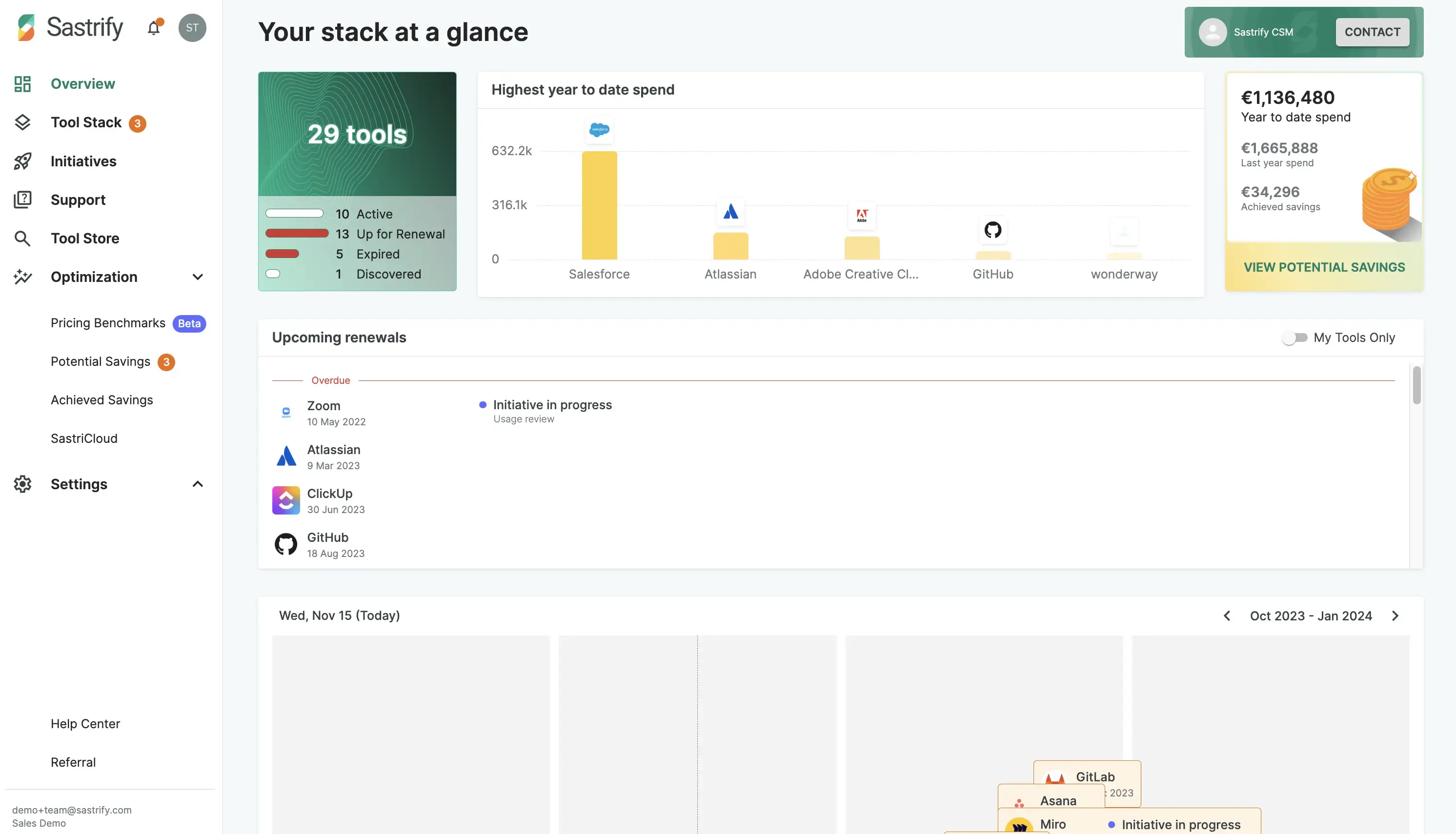
Maximilian Messing and Sven Lackinger founded the company in Germany in 2020. Since then, Sastrify has expanded beyond software contract tracking to include purchasing workflows and professional negotiation services.
Today, it sells three main services:
- Software management to track applications, analyse usage, manage contracts, and coordinate purchasing requests.
- Vendor benchmarks to compare supplier prices using Sastrify’s purchasing intelligence and get advice for negotiations.
- Expert procurement to work with professional buyers who can lead or support your supplier negotiations.
You don’t necessarily need all three, as an IT department might want help identifying unused software, while a finance team dealing with expensive renewals may care more about pricing benchmarks and negotiation support.
Sastrify also runs a software marketplace with selected supplier offers, giving customers another route to purchasing certain applications.
What changed after Deel acquired Sastrify?
Deel, the global HR and IT management company, acquired Sastrify in May 2026 for an undisclosed amount.
According to Deel's acquisition announcement, the goal is to expand its IT services beyond employee hardware and access management into software purchasing, usage tracking and renewals.
That could eventually make it easier for businesses to manage employee IT requirements and software subscriptions through connected services.
For now, Sastrify still maintains its own website, pricing page, and support documentation. Its platform demo also remains available.
We couldn't confirm a universal migration plan for existing customers or which Deel capabilities new Sastrify contracts might include.
What should you do?
If you’re already a customer, ask whether the acquisition changes your support arrangements or subscription terms. If you’re considering Sastrify for the first time, get a clear breakdown of the features and services your agreement will cover.
Who is Sastrify for?
Sastrify makes the most sense when managing software purchases has become difficult to coordinate across your company. You might have different departments buying similar applications, employees using tools that IT doesn't know about, or dozens of renewals that your finance team struggles to keep up with.
The platform can help you understand that activity, and its procurement specialists can take some of the negotiating work off your team's plate.
However, you'll still need someone internally to coordinate the process. Application owners must help maintain accurate information, and your company remains responsible for its purchasing decisions.
If you only manage a handful of subscriptions, Sastrify’s annual cost may be difficult to justify. A simpler SaaS contract management process might cover your needs.
Sastrify’s best features
Sastrify’s current platform helps teams discover software, coordinate purchases, and assess potential vendor risks. Here’s how those capabilities work.
Software discovery and usage analytics
Sastrify helps you build an inventory of the applications your employees use, including tools that nobody formally approved.
It gathers information through identity providers such as Microsoft Entra ID, Okta, and Google Workspace. Connections to financial systems and supported browser monitoring give you more visibility.
For example, suppose marketing and operations each pay for a different project-management platform. Sastrify can help you identify the overlap and examine usage before deciding whether both subscriptions are necessary.
Its Insights dashboard examines employee activity over a rolling 90-day period, while Shadow IT Radar helps administrators investigate unfamiliar software.
- We like how Sastrify combines information from several sources to give your team a broader view of its software estate.
- However, note that identity-provider data synchronises weekly, and usage insights depend on the systems and browsers you connect.
Low activity doesn’t automatically mean an employee no longer needs a licence. Check the supplier’s own records and speak with the application owner before cancelling seats.
Contract management and renewal alerts
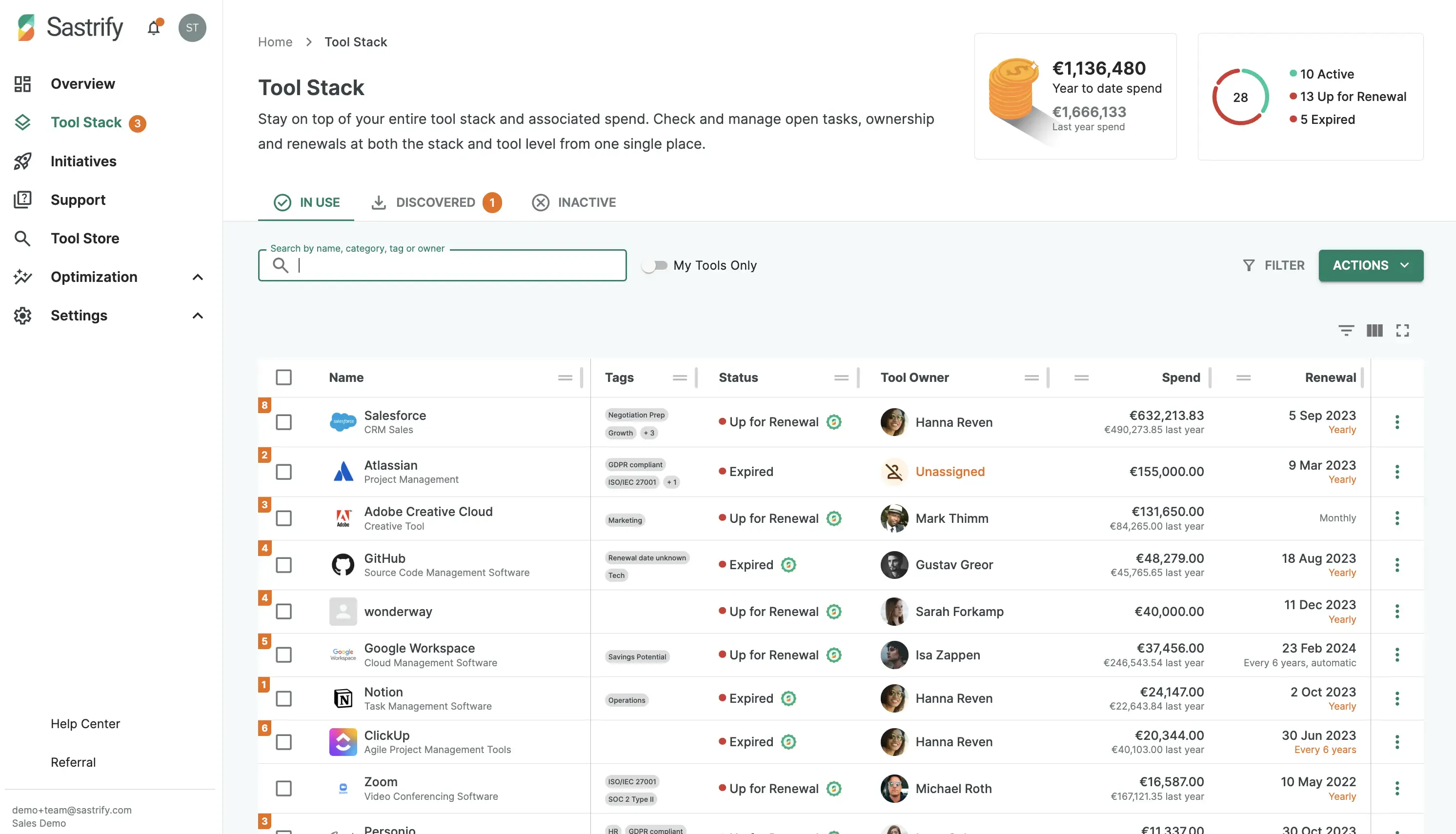
Sastrify gives your team one place to maintain software contracts and subscription details.
Its Contract AI feature reads uploaded PDFs and extracts information such as contract values, billing frequency, and renewal dates. You can review the results against the original document and correct any errors.
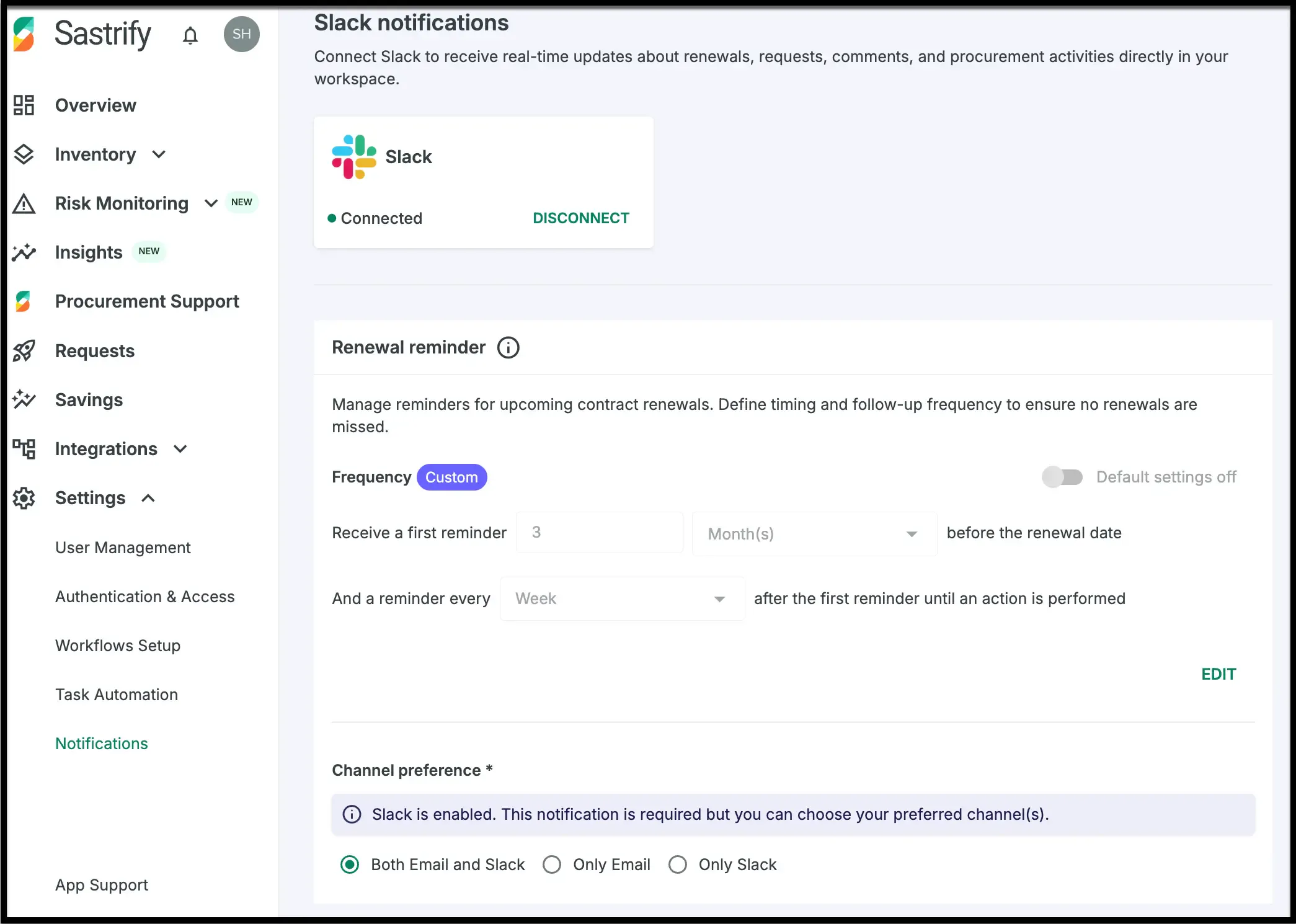
The platform also sends reminders ahead of renewal decisions. Its documentation describes a default process that starts three months before the relevant decision date, with follow-up reminders as the deadline approaches. This helps when a supplier requires cancellation notice well before the contract expires.
For example, a £60,000 annual contract might renew automatically unless you give 60 days' notice. If your team only notices the upcoming renewal two weeks before expiry, you may already have missed the cancellation window.
- The main benefit is having a more reliable process for keeping track of those dates.
- However, your team still needs to verify the extracted information and send any required notices.
Purchasing requests and approvals
Sastrify lets employees submit software requests through a common process instead of relying on scattered email conversations, and it connects with Slack for notifications and Jira for tracking procurement requests.
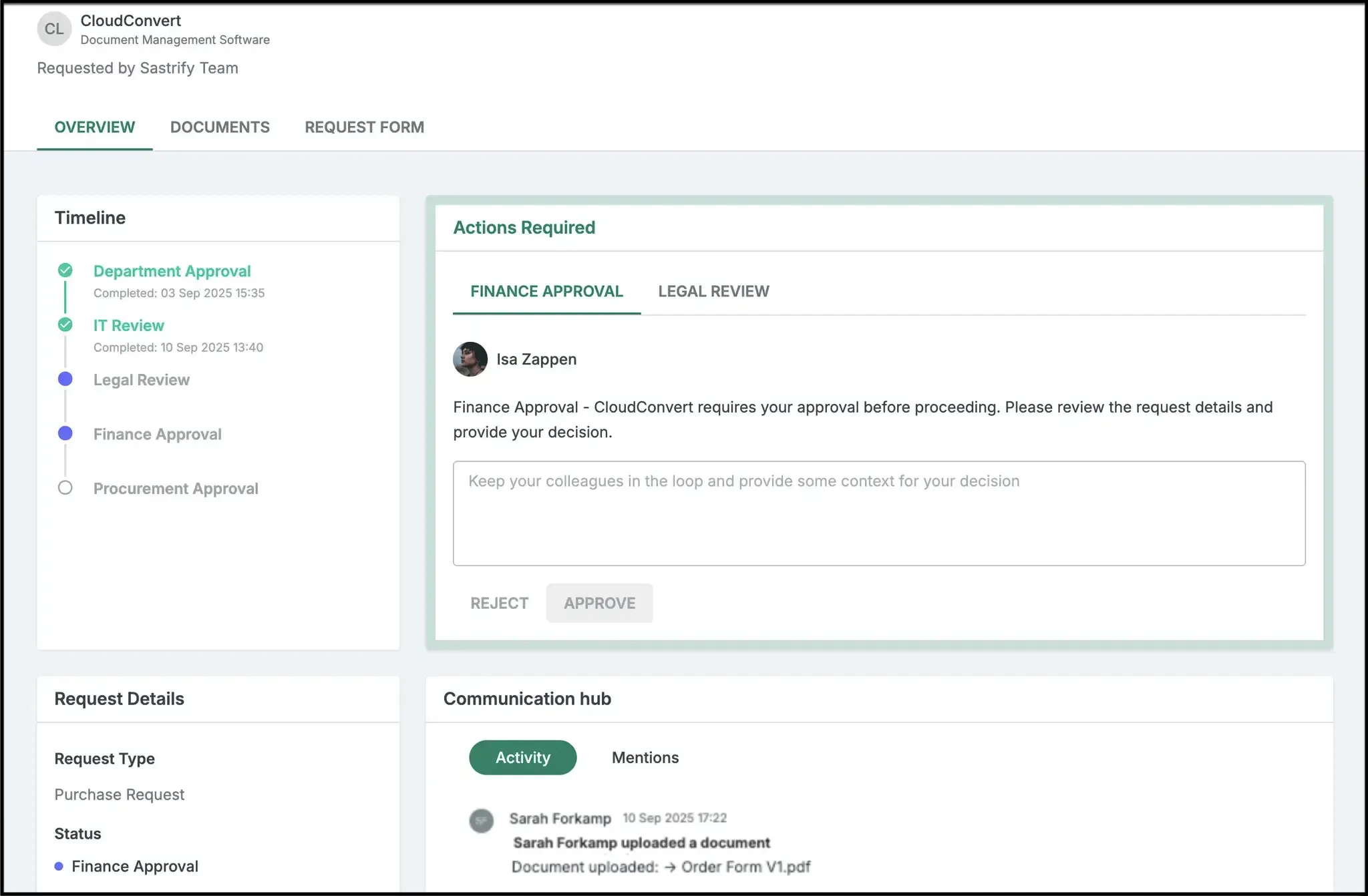
Your team can create forms for new purchases and renewals, collect the necessary details, and route requests to the relevant stakeholders.
You can also configure sequential or parallel approval stages. For instance, a department manager might approve the business need before finance reviews the budget.
Note
If your company has strict approval policies, Sastrify’s documentation explains that when a stage includes multiple approvers, one person can advance the request. That may suit ordinary purchasing decisions, but it isn’t the same as requiring everyone’s approval.
If your company needs more complex controls, ask Sastrify to demonstrate your actual approval process before you commit.
AI-powered vendor risk monitoring
Sastrify's Shadow IT Radar helps administrators investigate software that employees use outside approved processes.
It also includes an AI-powered risk assessment that assigns a score from 0 to 100. The system examines ten weighted categories, including information security, data protection, and supplier stability, and higher scores indicate greater potential risks.
- For an IT team managing hundreds of applications, this can help identify which vendors deserve closer attention.
- However, Sastrify relies on available supplier information to calculate those scores. A low-risk rating doesn’t replace a proper security review or guarantee compliance with regulations such as DORA or NIS2.
Use this feature as a starting point for your team’s due diligence rather than a final decision about supplier safety.
How does Sastrify’s procurement service work?
Sastrify’s professional buyers are part of its appeal, especially if your employees spend too much negotiating software contracts.
Through Expert Procurement, your team can involve its specialists in upcoming purchases and renewals.
You can work with its buyers in three ways:
Arrangement | How it works |
|---|---|
Lead negotiator | Sastrify's specialist leads the conversation with the supplier |
Supporting negotiator | Your team leads while Sastrify provides assistance |
Negotiation coaching | You negotiate directly using Sastrify's advice and benchmarks |
This flexibility can be useful if you prefer to keep direct contact with strategic suppliers but want help managing routine renewals.
Sastrify’s specialists use information from previous negotiations and market research to assess quotes. They may recommend different licence quantities, better payment terms, or a more competitive target price.
Of course, the quality of a benchmark depends on how closely it matches your purchase. A quote for 500 Salesforce licenses on a three-year commitment won’t necessarily tell you what a much smaller company should pay.
There are also limits to the service:
- Sastrify’s standard negotiation scope excludes legal and IT-security contract reviews.
- It doesn’t cover a full technical evaluation of alternative products against your business requirements.
- Your contract may also limit the number of negotiations you can request each year.
Which integrations does Sastrify support?
Sastrify works with several types of business software to help your team understand employee activity and supplier spending, including accounting systems, identity providers, and collaboration applications.
System | What Sastrify uses it for |
|---|---|
Microsoft Entra ID, Okta, and Google Workspace | Employee identities and software discovery |
Xero and QuickBooks | Supplier spending and accounting information |
NetSuite and Sage Intacct | Financial records and vendor information |
Slack | Procurement notifications |
Jira | Procurement requests and related communications |
HR systems | Employee and department information |
The connections don’t all support the same activities. For example, Sastrify may retrieve supplier information from your accounting system without allowing you to create purchase orders or execute payments through that connection.
If your business uses Sage, check the exact edition. Sastrify’s documentation supports Sage Business Cloud and Sage Inttact through its accounting integration route, but not Sage 50 or Sage 200cloud.
Its DATEV documentation also describes a file import and export process rather than an automatic live connection.
How much does Sastrify cost?
Sastrify publishes annual starting prices for its three main services, and you can pay in euros, pounds, or US dollars.
Service | EUR/year |
|---|---|
Software Management | From €12,500 |
Vendor Benchmarks | From €15,000 |
Expert Procurement | From €25,000 |
Yes, Sastrify keeps the same numerical starting price when you switch currencies; there’s no live exchange-rate conversion. That’s likely because you’ll need a custom quote to establish the full cost anyway.
The public pricing page doesn't fully explain how the different services combine, how Sastrify counts identities, or what additional implementation and negotiation support might cost. They discuss these details with you during your sales call.
What happened to Sastrify Essentials?
You may still find an older Essentials subscription in software directories.
G2 lists Essentials at €750 annually, while Capterra and Software Advice show €750 monthly. Historical articles also mention Professional and Platinum packages that don't appear in the current pricing structure.
- Sastrify doesn’t sell an Essentials package anymore, so always rely on the official three-service pricing as the basis of your budget.
- Sastrify also advertises a 14-day platform trial in its blog posts. This is also a confusing point for potential users. As of October 2026, you can only request a demo of the platform.
Does Sastrify guarantee savings?
Sastrify advertises an ROI Guarantee for Vendor Benchmarks and Expert Procurement. That's reassuring when you're considering an annual service costing tens of thousands, but it's important to understand how the company measures the results.
According to Sastrify's savings FAQ, its calculations can include negotiated discounts and avoided supplier price increases. Those benefits aren't always the same as reducing your existing software bill.
Let’s look at an example of cost avoidance vs. cash savings.
Suppose your current software contract costs £100,000 annually. At renewal, the supplier proposes increasing the price to £120,000. Sastrify negotiates the final amount down to £105,000.
Measure | Amount |
|---|---|
Previous annual contract cost | £100,000 |
Supplier's renewal quote | £120,000 |
Final negotiated price | £105,000 |
Reduction against the supplier's quote | £15,000 |
Actual increase against last year's bill | £5,000 |
You avoided £15,000 of the proposed increase, which has commercial value. However, your company still spends £5,000 more than it did last year. These figures simply measure different outcomes, so neither is wrong.
Sastrify also counts certain savings over the full contract term. If you negotiate a £10,000 annual reduction on a two-year agreement, it may record £20,000 in total contractual savings.
That means you should compare savings and service fees over matching periods.
The public documentation explains Sastrify's savings calculations, but we couldn't find the complete contractual conditions governing its advertised ROI Guarantee.
Before signing, make sure you ask these questions:
- Which purchases and renewals count towards the guarantee?
- Does Sastrify compare prices against your previous contract or the supplier's opening quote?
- Do avoided increases and reduced licence quantities count towards the target?
- What happens if the service doesn't achieve the guaranteed result?
- Will you receive a refund, credit or another remedy?
You should also confirm which services qualify. Sastrify currently advertises the guarantee alongside Vendor Benchmarks and Expert Procurement, rather than every module.
What do customers say about Sastrify?
Sastrify is positively received for its procurement specialists and the visibility its platform provides over software spending, though some customers think that its reporting features are limited and the amount of internal work required to get the most from the service is high.
Here’s how the ratings compared during our October 2026 research.
The Capterra and OMR samples are small, and several G2 reviews carry incentive labels. Most detailed customer accounts also predate Deel's acquisition, so they don't tell us how ownership changes have affected the service.
The general consensus is that customers value working with Sastrify’s buyers and account managers. They also describe the onboarding experience as easy and the renewal reminders and contract system as convenient.
However, even satisfied customers admit that the platform needs active participation from the business. For example:
“The bigger lifts in using Sastrify are around adoption from tool owners. On setup, admins will need to get them to update the tools in the system and to engage with the tool on renewals - if a user doesn't own many tools they may not engage with Sastrify frequently enough to learn the system well.”
Marian-Emilian G. made a similar observation, explaining that companies should assign an internal coordinator:
“It's not a downside, just a point of attention, in order to be able to save a lot of money, a person in charge of Sastrify is needed internally, to check contracts date expiration and follow up with tools' owner.”
Meanwhile, some users think that the platform may have become slightly convoluted recently and would’ve appreciated more flexible management reports:
“The platform has grown quite a bit and, at times, the interface feels a bit overwhelmed by the number of features. The generation of custom reports to present to the management could be more flexible; nowadays we rely to some extent on pre-established formats”
Other customers mentioned excessive notifications or slower support during periods with several simultaneous renewals, though the overall picture remains encouraging.
Sastrify pros and cons
Here’s a summary of Sastrify’s strengths and limitations based on what users reported:
Pros | Cons |
|---|---|
Combines software visibility with procurement support | Different modules can increase your total cost |
Helps identify duplicate applications and unused licences | Usage insights depend on connected systems |
Provides pricing benchmarks and professional buyers | Negotiation services may have contractual limits |
Tracks contracts and renewal deadlines | Employees still need to maintain information |
Publishes starting prices in three currencies | Complete pricing and guarantee conditions require clarification |
Customers praise its procurement specialists | Some report difficulties with reporting and negotiations |
If your organisation wants to understand its software estate before deciding where to reduce spending, Sastrify might be useful.
Though you should focus on the Expert Procurement Service rather than the software discovery features if your biggest headache is negotiating renewals.
Sastrify’s best alternative: Najar
Najar is the best alternative to Sastrify. Both companies help you manage software spending and negotiate supplier contracts, but they have different strengths:
- Sastrify focuses on software discovery and usage tracking.
- Najar puts more emphasis on helping your team choose suitable vendors and negotiate better deals.
Here’s how they compare:
Sastrify | Najar | |
|---|---|---|
Main focus | SaaS management and procurement services | Indirect procurement, mainly IT and software |
Key strengths | Software discovery, usage analytics and vendor risk monitoring | Vendor evaluation, pricing benchmarks and expert negotiations |
Human negotiators | Available through Expert Procurement | Dedicated IT buyers who can handle negotiations |
Pricing intelligence | Advertised database covering $6B+ in spending | €6B+ in analysed European spend data and experience negotiating with 25,000+ vendors |
Pricing model | Separate services from 12,500/year | Annual flat fee based on the agreed scope |
Savings guarantee | Advertised ROI Guarantee; full remedy requires confirmation | Savings guarantee with a proportional service-fee refund, subject to contractual conditions |
Setup | Depends on integrations and configuration | Approximately 10 days |
If your team spends too much time choosing vendors and negotiating renewals, Najar takes a more hands-on approach.
Its IT buyers can manage negotiations for you, or you can use its benchmarks to negotiate directly. Najar can also help you evaluate vendor options before you make a purchasing decision.
Our verdict on Sastrify
If you manage a large SaaS portfolio and want better visibility into software usage, contracts, and renewals, Sastrify is a strong option. Its procurement specialists get positive feedback, and the platform gives IT teams useful tools for discovering applications and monitoring vendor risk.
The main drawbacks are its modular pricing and the limits on its negotiation service. Before signing, make sure you understand what your package includes, how Sastrify calculates savings, and whether the Deel acquisition will affect your agreement.
If negotiation is what you need most, compare it with Najar. Our IT buyers negotiate on your behalf, backed by a savings guarantee and benchmarks from €6B in analysed European spend data.
Bring an upcoming renewal to a demo, and we'll show you what a better deal could look like
Frequently Asked Questions (FAQs)
Is Sastrify now part of Deel?
Yes. Deel acquired Sastrify in May 2026 to expand its software-management and procurement capabilities.
Sastrify continues to promote its own platform and services. If you're an existing customer, ask your account manager about any changes to contracts, support or future product access.
How much does Sastrify cost?
Sastrify advertises Software Management from €12,500, Vendor Benchmarks from €15,000 and Expert Procurement from €25,000 annually.
Its website also displays the same numerical starting amounts in GBP and USD when you switch currencies.
You'll need a custom quote for the complete cost of your selected services.
Can you still buy Sastrify Essentials?
Older software directories list an Essentials subscription, but they disagree about its price and billing period.
Sastrify's current website instead advertises three services with separate annual starting prices. The company doesn’t publicly advertise an Essentials plan anymore.
Does Sastrify offer a free trial?
No, Sastrify offers a demo. Although there are mentions of a 14-day free trial across its blog posts, there isn’t any hint of a 14-day free trial of its software management platform on the website.
Does Sastrify guarantee savings?
Sastrify advertises an ROI Guarantee for its Vendor Benchmarks and Expert Procurement services.
Its savings methodology can count negotiated price reductions and avoided supplier increases, so recorded savings won't always equal a reduction in your previous spending.
Request the full guarantee conditions and refund or credit terms before signing.
Does Sastrify support Xero, Sage and NetSuite?
Yes. Sastrify documents integrations involving Xero, NetSuite and certain Sage products.
Its supported Sage accounting connections include Sage Business Cloud and Sage Intacct, but not Sage 50 or Sage 200cloud through the documented route.
Check the exact application edition and data access your company needs.
Can Sastrify negotiate and cancel software contracts for you?
Sastrify's procurement specialists can lead or assist with software negotiations, depending on your contract.
Your company remains responsible for making purchasing decisions and sending valid cancellation notices.
Most supplier contracts remain between your business and the vendor, although Sastrify also has separate reseller arrangements for selected products.
Is Sastrify suitable for small businesses?
It depends on how much software your company manages and which services you need.
A business with only a handful of subscriptions may struggle to justify Sastrify's annual starting prices. A growing company with many contracts and frequent renewals could get more value from its software visibility and procurement support.
Before subscribing, compare the annual fee with the time and spending the service could realistically help your team recover.