
Why are we still using 1980s procurement logic for 2026 AI technology?
A contract you signed 12 months ago just auto-renewed. The AI tool it covers has been outperformed by three newer alternatives. The vendor has quietly embedded generative AI features that change your data and liability exposure. And EU regulation now gives you the right to walk away from cloud contracts with minimal notice.
Yet the contract rolled forward. Nobody reviewed it. Sound familiar?
Auto-renewals, those ‘evergreen’ clauses that extend agreements unless notice is served, have long been the backbone of IT service continuity. They reduce administration, prevent service gaps, and give vendors predictable revenue (Lysons and Farrington, 2020). But in 2026, with AI innovation cycles measured in months and regulation dismantling traditional lock-in, the question is no longer whether auto-renewals are convenient. It is whether they are strategically defensible across your entire IT procurement portfolio.
When Auto-Renewals Still Earn Their Place
I am not advocating wholesale elimination. For commoditised, stable IT categories, network monitoring, endpoint security, established ERP maintenance, and print management, the cost of renegotiating every cycle often exceeds the potential savings. Van Weele (2018) argues that for routine, low-risk purchases with stable suppliers, transactional efficiency should take precedence. The CIPS Contract Management Cycle reinforces this: management effort should be proportionate to strategic importance (CIPS, 2024).
Auto-renewals also support regulatory compliance in heavily regulated sectors. Under DORA, financial entities must maintain documented, tested ICT third-party arrangements (European Parliament, 2022). An auto-renewal paired with annual performance reviews and indexed pricing caps can evidence ongoing governance, and as Monczka et al. (2020) note, predictable commitments incentivise vendors to invest in continuous service improvement.
The critical distinction: these must be deliberate, governed choices, not defaults born of missed deadlines or absent oversight.
Why AI and High-Innovation Categories Demand a Different Approach
Innovation outpaces contract cycles:
Gartner forecasts enterprise software spend rising at least 40% by 2027, with generative AI as the primary accelerant. CIOs are now setting aside 9% of IT budgets simply to absorb price increases on existing services (Gartner, 2025a). Vendors are layering AI tiers into existing platforms, shifting to consumption-based pricing, and introducing premium features mid-term, driving cost volatility without corresponding contract updates. Meanwhile, Flexera’s 2025 State of the Cloud Report found that 84% of organisations consider managing cloud spend their top challenge, with budgets already exceeding limits by 17% (Flexera, 2025).
I have seen this firsthand. A client auto-renewed a document intelligence platform without benchmarking it against the market. Within six months, a competitor launched a solution with significantly better extraction accuracy at a lower cost. The client was locked in for another twelve months, paying premium rates for yesterday’s technology.
Regulation now decisively favours buyer flexibility:
The EU Data Act’s cloud switching provisions, applicable since September 2025, require SaaS, PaaS, and IaaS providers to facilitate termination with no more than two months’ notice. By January 2027, switching fees must be phased out entirely (European Commission, 2025). Crucially, these statutory rights apply retroactively, even to contracts signed before September 2025 (DLA Piper, 2025). Your evergreen clause may still sit in the contract, but the law now gives you the right to override it.
AI features silently alter your risk profile:
When a vendor embeds generative AI capabilities mid-contract, questions of data ownership, model training on customer data, IP liability for AI-generated outputs, bias mitigation, and EU AI Act compliance all surface, none of which may be addressed in your existing terms (Bryan Cave Leighton Paisner, 2025). An auto-renewal that rolls forward last year’s contract simply carries these exposures forward unexamined.
A Practical Framework: The AI-Era Renewal Matrix
Not every contract warrants the same approach. Drawing on Kraljic’s (1983) portfolio logic, I recommend segmenting your IT contracts along two axes: the rate of innovation in the technology category and its strategic importance to the business. This produces a clear decision matrix:
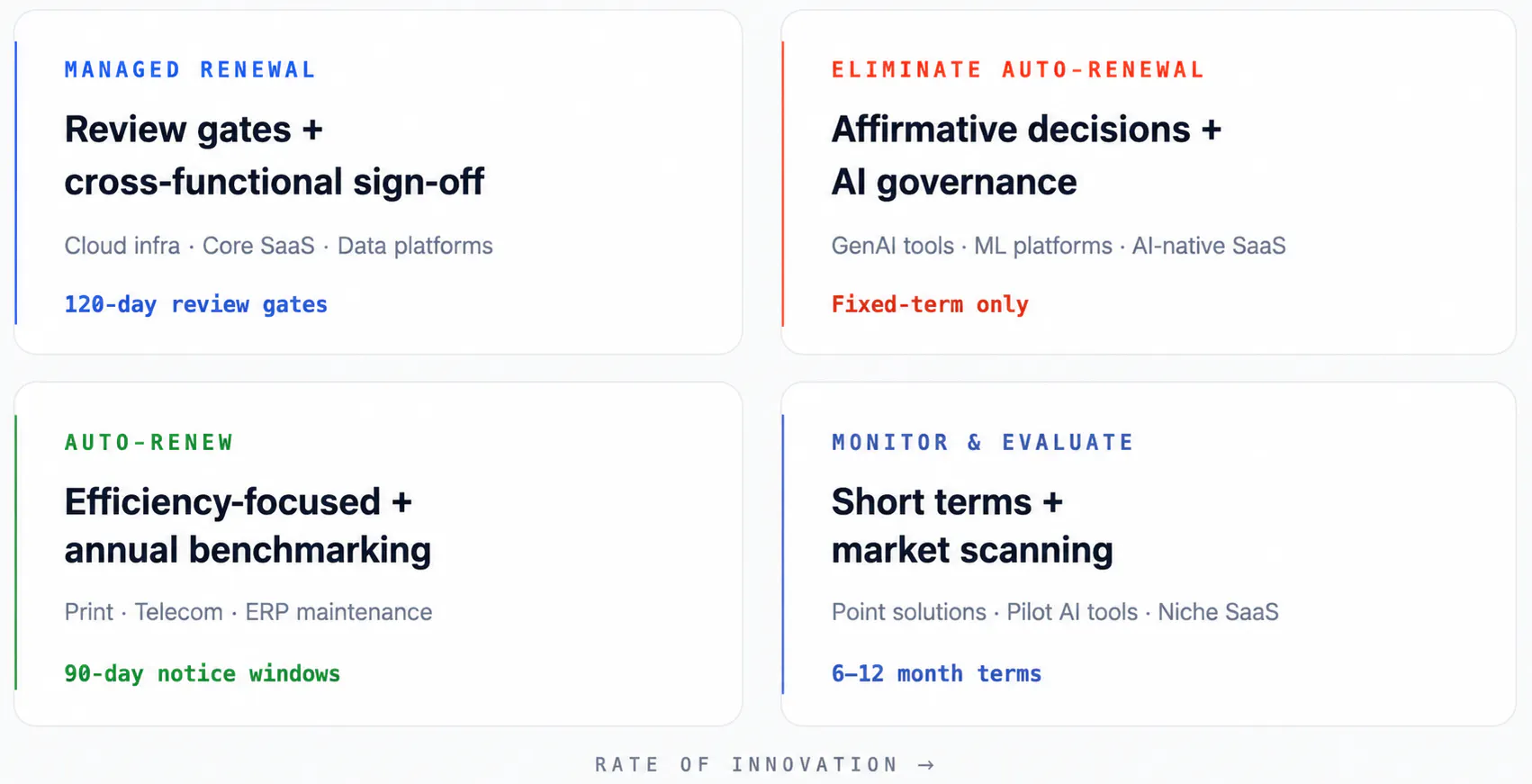
Low Innovation / Low Strategic Importance (e.g., print services, telecom circuits) → Auto-Renew. Focus on efficiency. Include annual benchmarking clauses, capped uplifts, and 90–120 day notice windows.
High Strategic / Moderate Innovation (e.g., cloud infrastructure, core SaaS platforms) → Managed Renewal. Keep auto-renewal convenience but mandate structured review gates 120 days before expiry, with cross-functional sign-off from procurement, legal, IT, and finance, plus annual AI impact assessments.
High Innovation / High Strategic Importance (e.g., GenAI tools, ML platforms, AI-native SaaS) → Eliminate Auto-Renewal. Require affirmative renewal decisions. Build in technology refresh clauses, market benchmarking rights, and comprehensive AI governance covering data training restrictions, IP liability, and bias and fairness commitments.
Gartner predicts that by 2027, 50% of organisations will use AI-enabled contract risk analysis tools to support supplier negotiations (Gartner, 2024). Yet World Commerce and Contracting’s 2025 research shows only 17% of organisations currently have defined AI contracting plans (World Commerce and Contracting, 2025). This matrix bridges the gap while the tooling matures.
Your Monday Morning Checklist
Use this to turn the insights above into immediate action:
☐ Audit passive renewals. Prioritise AI-enabled tools and cloud contracts where vendors have recently changed pricing or added features.
☐ Assert your Data Act rights. Confirm your legal team understands that cloud switching provisions now supersede restrictive evergreen clauses.
☐ Update AI governance. Ensure no AI contract renews without terms covering model training restrictions, IP liability, and bias mitigation.
☐ Segment the portfolio. Map each contract onto the renewal matrix. Identify which deserve passive auto-renewal, which need managed review gates, and which require fixed-term affirmative decisions.
☐ Upgrade the tooling. Move away from spreadsheets and calendar reminders. I would recommend looking at platforms like Najar, which combines automated renewal tracking and contract intelligence with a team of seasoned IT buyers who negotiate year-round with vendors.
Auto-renewals are a tool, not a strategy. In stable IT categories, they deliver efficiency. But across AI, cloud, and rapidly evolving SaaS, where innovation outpaces contract terms and regulation is dismantling lock-in, allowing a renewal to happen automatically is itself a strategic decision. Make sure yours is a deliberate one.
Step into the cockpit of financial excellence
References
Bansal, A. and Jain, R. (2023) ‘AI-driven contract management: automation and decision support in procurement,’ Journal of Procurement Technology, 15(2), pp. 112–128.
Bryan Cave Leighton Paisner (2025) Reviewing SaaS agreements in the age of AI. Available at: https://www.bclplaw.com/en-US/events-insights-news/reviewing-saas-agreements-in-the-age-of-ai.html (Accessed: 13 February 2026).
Chartered Institute of Procurement & Supply (CIPS) (2024) Contract management cycle. Available at: https://www.cips.org/intelligence-hub/contract-management/cycle (Accessed: 13 February 2026).
DLA Piper (2025) Understanding switching rights under the Data Act. Available at: https://www.dlapiper.com/en/insights/publications/2025/07/understanding-switching-termination-rights-under-the-data-act (Accessed: 12 February 2026).
European Commission (2025) The Data Act. Available at: https://digital-strategy.ec.europa.eu/en/policies/data-act (Accessed: 12 February 2026).
European Parliament (2022) Regulation (EU) 2022/2554 on digital operational resilience for the financial sector (DORA). Official Journal of the European Union, L333/1.
Flexera (2025) 2025 State of the Cloud Report. Itasca, IL: Flexera. Available at: https://www.flexera.com/about-us/press-center/new-flexera-report-finds-84-percent-of-organizations-struggle-to-manage-cloud-spend (Accessed: 13 February 2026).
Gartner (2024) Gartner predicts half of procurement contract management will be AI-enabled by 2027. Available at: https://www.gartner.com/en/newsroom/press-releases/2024-05-08 (Accessed: 13 February 2026).
Gartner (2025a) ‘Enterprise software spend will grow 15.2% in 2026,’ as cited in SaaStr, 28 November 2025. Available at: https://www.saastr.com/gartner-enterprise-software-spend-will-grow-a-stunning-15-2-next-year (Accessed: 13 February 2026).
Kraljic, P. (1983) ‘Purchasing must become supply management,’ Harvard Business Review, 61(5), pp. 109–117.
Lysons, K. and Farrington, B. (2020) Procurement and supply chain management. 10th edn. Harlow: Pearson Education.
Monczka, R.M., Handfield, R.B., Giunipero, L.C. and Patterson, J.L. (2020) Purchasing and supply chain management. 7th edn. Boston: Cengage Learning.
Van Weele, A.J. (2018) Purchasing and supply chain management. 7th edn. Andover: Cengage Learning EMEA.
World Commerce and Contracting (2025) AI adoption in contracting: aspiration and excitement. Available at: https://www.worldcc.com/Portals/IACCM/Reports/AI-adoption-in-Contracting.pdf (Accessed: 12 February 2026).