
Spendflo combines procurement software with a team of buyers who negotiate software contracts on your behalf. Its platform handles purchasing requests, approvals, contracts, and invoices, while its negotiation service helps companies manage renewals and supplier pricing.
But those two parts of Spendflo aren't necessarily included in the same price. In our Spendflo review, we examined the solution’s plans, contract terms, and more than 50 customer reviews to find out what buyers actually get, how its savings guarantee works, and what to check before signing.
Disclaimer
This review is published by Najar, a competitor of Spendflo. We’ve kept it fair by sticking to what Spendflo publishes and what its customers say, and every claim below links to its source. Where Spendflo does something better than us, we say so. To research this, we read Spendflo’s pricing page, full feature comparison, product updates, help centre, Terms of Use, Platform Terms, and Data Processing Agreement. We watched its product videos and customer testimonials, read published customer stories, and went through more than 50 reviews on G2 and Capterra. Everything is up-to-date as of October 2026.
What is Spendflo?
Spendflo is an AI-based procurement platform built around SaaS purchasing, with a team of experts who negotiate your software contracts for you.
It was founded in 2021 by Siddharth Sridharan, Ajay Vardhan, and Rajiv Ramanan, is headquartered in San Francisco, and raised an $11 million Series A led by Prosus Ventures and Accel in 2023.
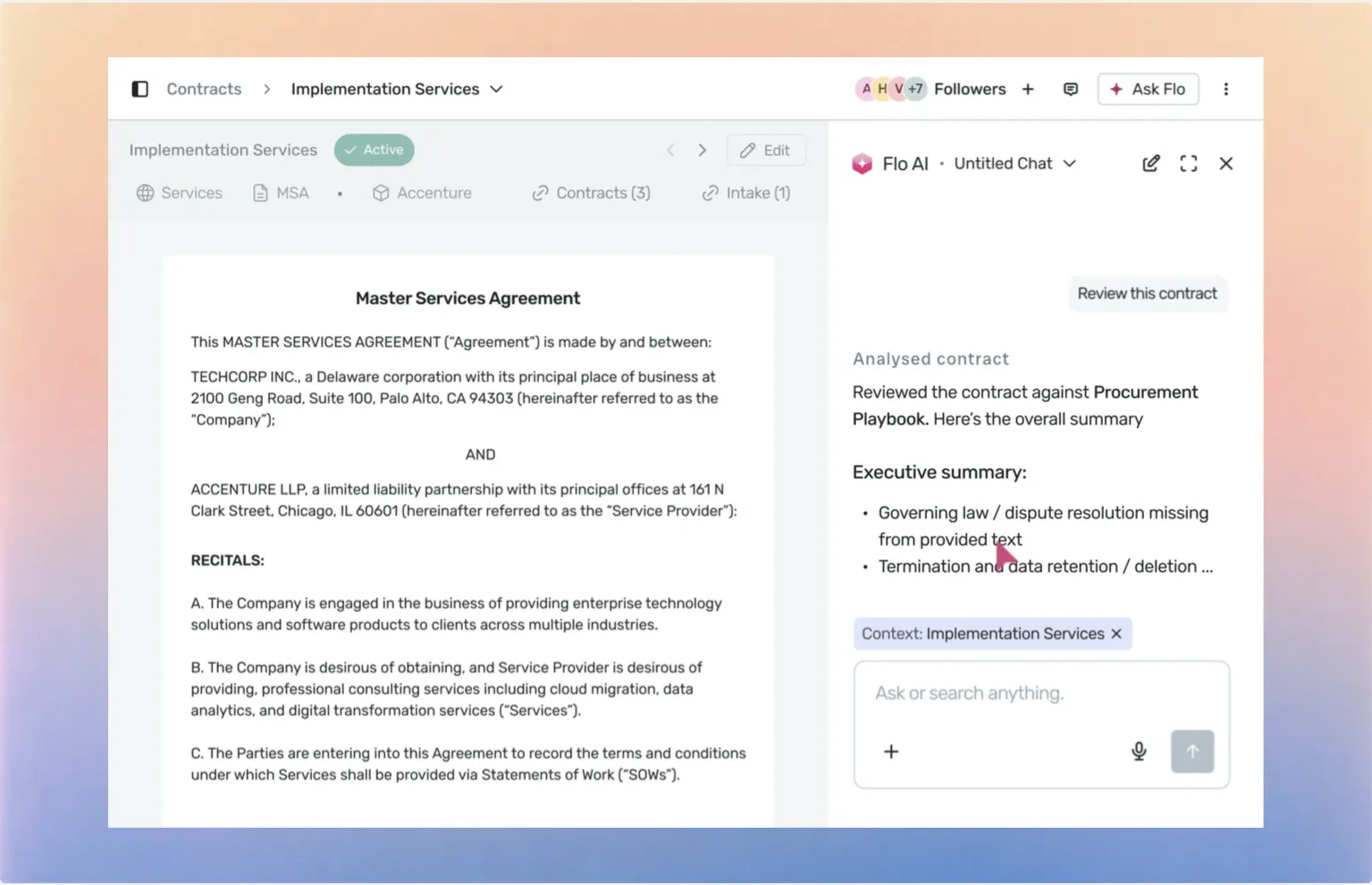
It started with software buying: tracking your SaaS stack, flagging renewals, and negotiating better prices. Today it's two products in one:
- The platform, which now runs from purchase request to invoice payment, is powered by an AI assistant called Flo.
- Managed procurement, where a dedicated team of buyers negotiates your software contracts for you.
Spendflo expanded its AI capabilities in 2026 with Flo, a system of agents covering procurement requests, contract analysis, and accounts payable.
These features are part of its broader intake-to-pay platform, although their availability varies by plan.
Who is Spendflo for?
Spendflo fits best if you're a US-based, mid-sized company with a growing software bill, a finance team that owns purchasing, and no dedicated procurement team.
Its own pricing page describes the entry plan as built for "teams with no procurement function”. It's a good match if:
- Your finance or IT team manages numerous software renewals.
- Employees submit purchasing requests through different channels.
- You need structured approval workflows and contract tracking.
- You want procurement specialists to negotiate supplier agreements.
- Your business already uses supported applications such as NetSuite, Slack or Microsoft Teams.
It's a weaker match if you're based in Europe and need your data hosted in the EU, if you want a purely self-serve tool, or if most of your spend isn't software.
What features does Spendflo have?
Here’s a breakdown of Spendflo’s main features and what each one does.
Intake and approval workflows
Every purchase starts as a request, and Spendflo lets employees raise one in plain English, in Slack, Microsoft Teams, email, or the platform itself.
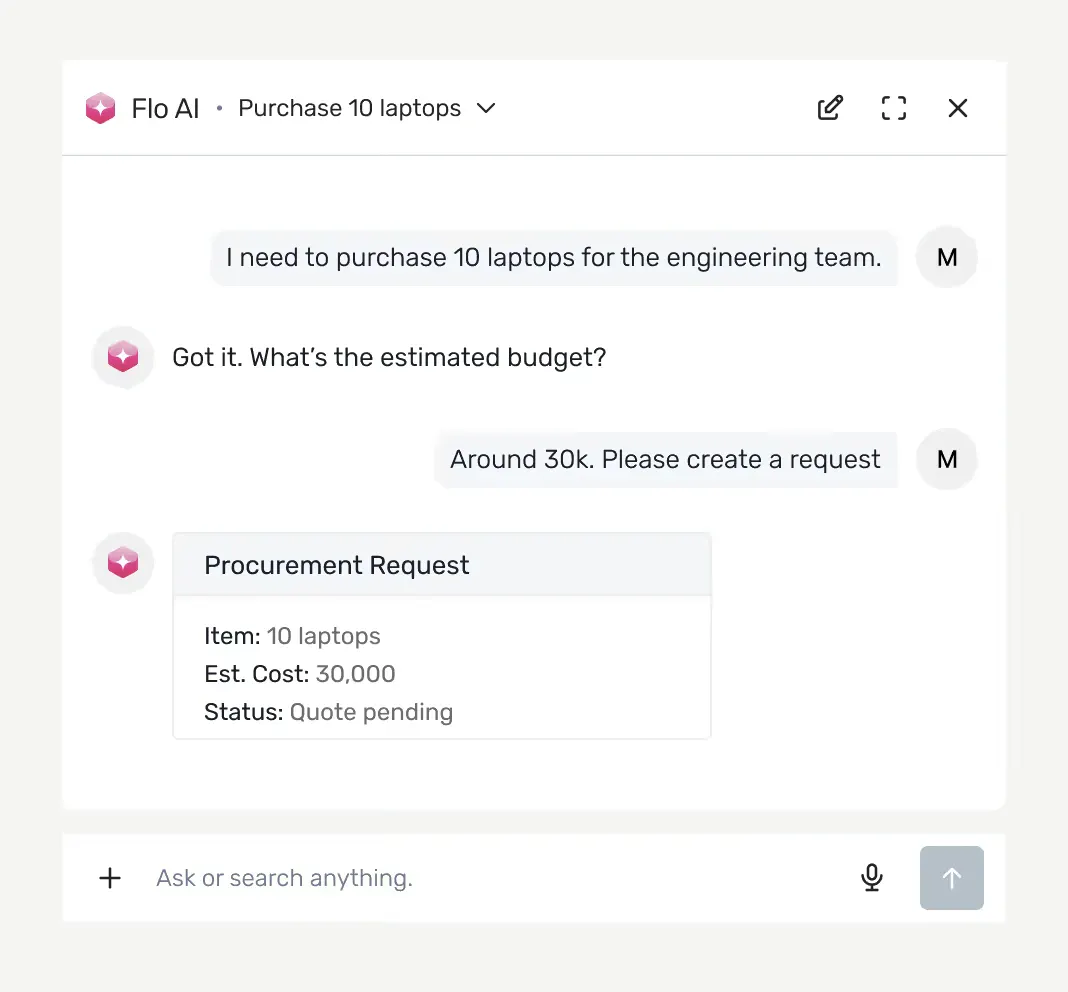
Flo turns the message into a structured request, asks for anything missing, like the budget, and sends it down the right approval path.
Admins build those paths in a no-code workflow builder, with routing by cost centre, spend threshold, or category.
There are templates for common requests like hardware, software, and supplier onboarding, and every stage runs against an SLA, so you can see which step is holding things up.
The no-code workflows allow companies to manage requests through tools their employees already use. However, AI-powered intake features such as Flo Copilot are available only on the Scale plan and above.
Besides that, Julie N., a controller reviewing Spendflo on Capterra, noted a limitation:
“We still need to submit renewal requests, despite Spendflo having full visibility of our renewal dates.”
Managed procurement and negotiation
This is what Spendflo customers talk about most. A dedicated "pod" of category experts negotiates your software contracts, benchmarks every renewal, and tracks savings monthly against committed targets. You approve the deal, and they handle the back-and-forth.
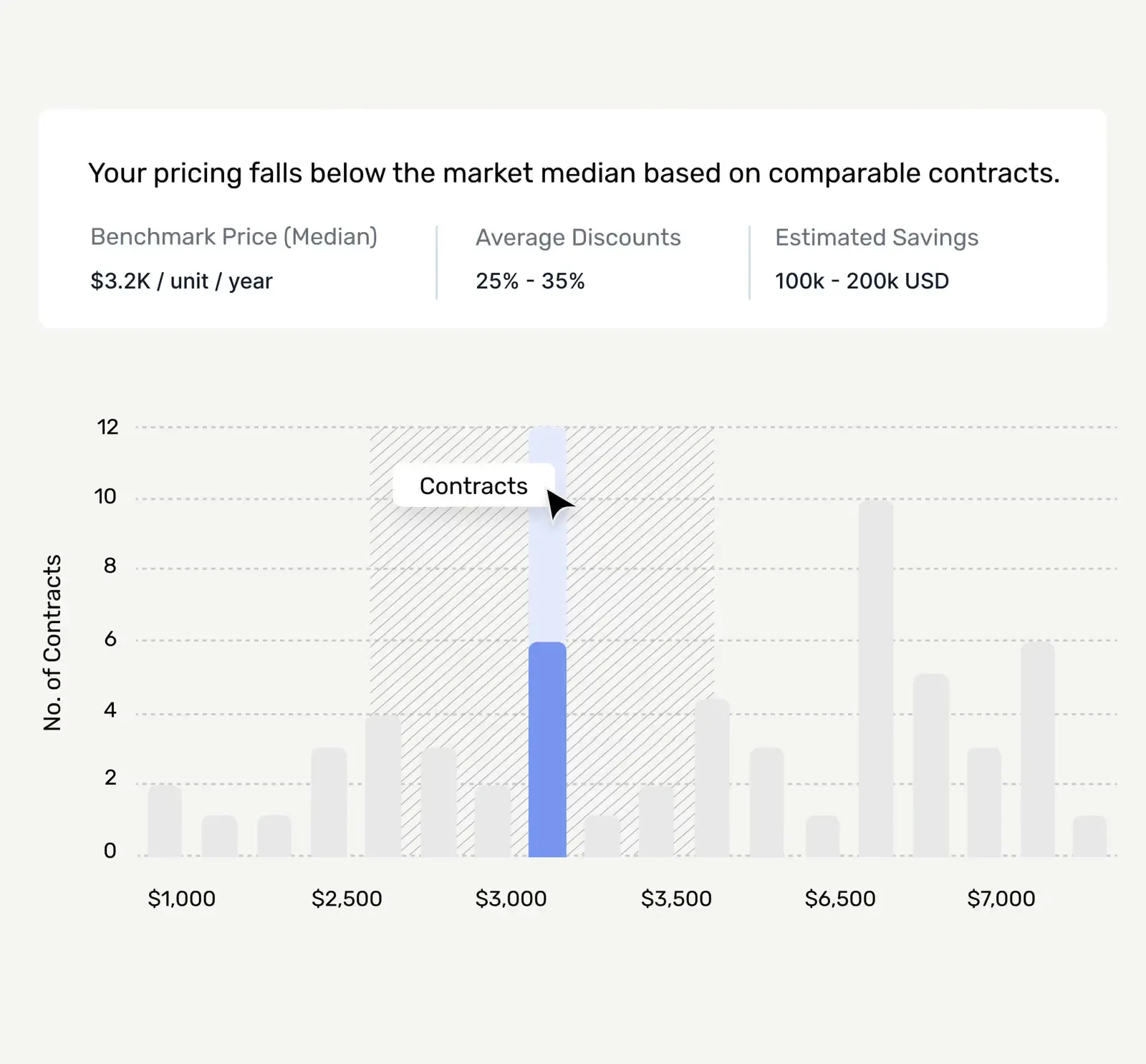
Reviewers describe the team as an extension of their own. Their results vary, though, and they depend on the individual buyer you work with.
The main advantage is having experienced buyers handle vendor contract negotiations without adding headcount. However, managed negotiation is a separate service, and the savings guarantee depends on the terms of your agreement.
Not every customer was satisfied with the negotiation service, though. In a July 2024 G2 review, Tom A., a data analyst and analytics manager, said Spendflo had claimed credit for discounts he already negotiated.
“They actually claimed credit for discounts I had already negotiated with the vendor before they got involved.”
Contract management and renewals
Spendflo reads contracts the moment they arrive, by email or bulk upload, and pulls out the supplier, term, value, and payment window. Renewal alerts go out 30, 60, or 90 days ahead, so nothing auto-renews unnoticed.
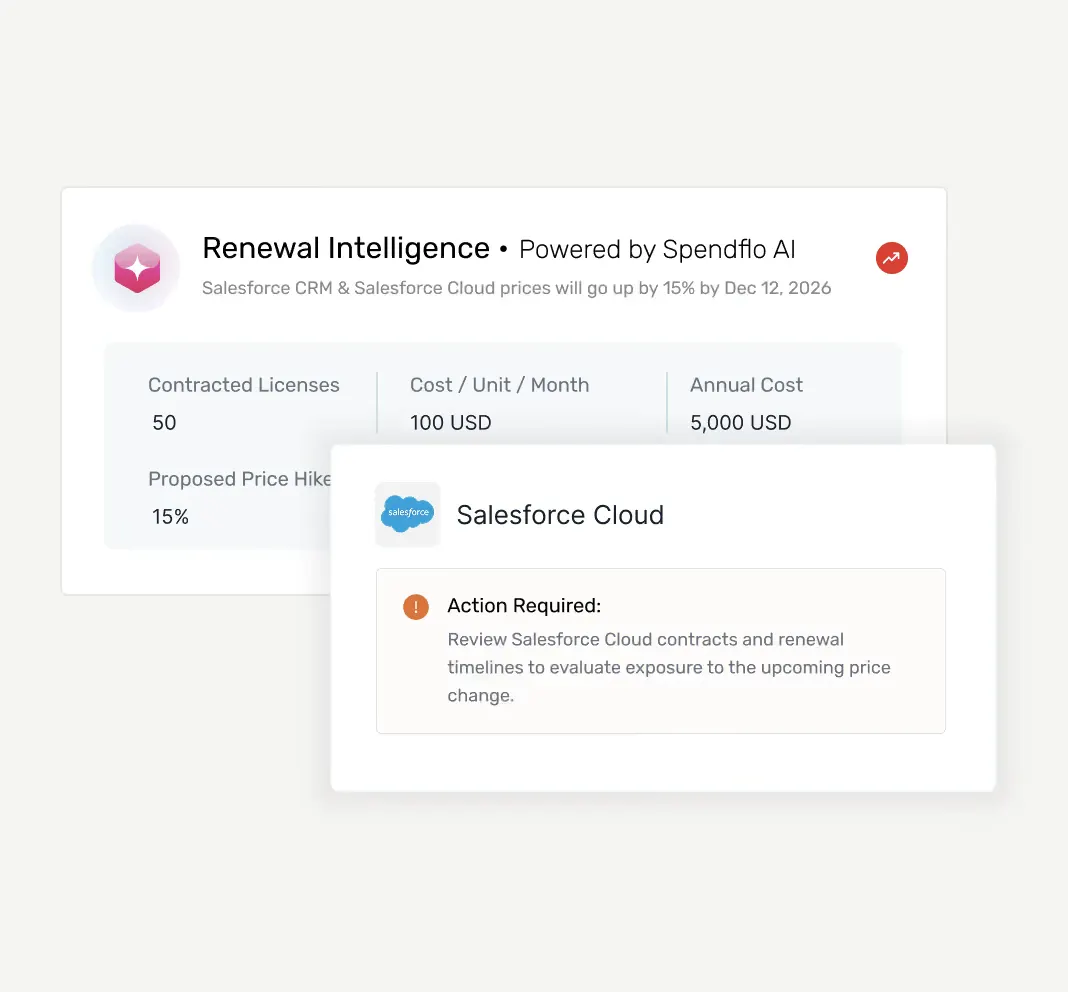
On the Scale plan and above, AI also flags risky clauses, like liability, data protection, or spend lock-in, with a severity score. Spendflo's August product roundup added renewal comparisons that surface changes in quantities, unit prices, and terms year on year.
Although automatic contract extraction and renewal tracking are available on every plan, AI contract review and risk flags aren’t included in Grow, and global contract search is Enterprise-only.
Pricing benchmarks and supplier intelligence
Before a request turns into spend, Spendflo compares the price against its benchmark data and flags duplicate tools you already own.
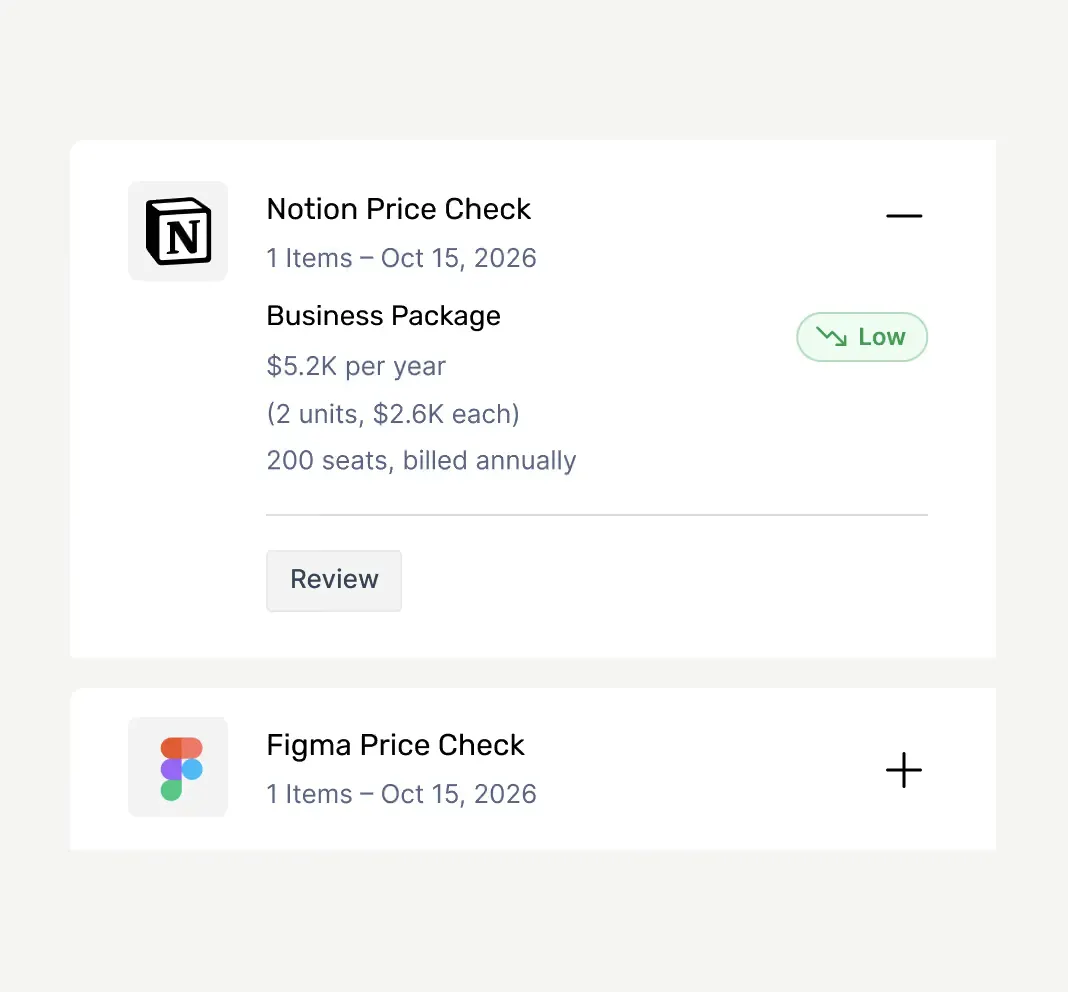
It also flags vendor-wide price increases before your renewal date and spots auto-renewal clauses 60 days out, with benchmark data attached.
Benchmarks are included in every plan, which is useful even if you negotiate yourself, but Spendflo doesn’t publish how big its pricing dataset is compared with its alternatives, so it’s hard to judge depth.
The reliability of SaaS pricing benchmarks depends on comparing relevant deals, including similar licence quantities, contract lengths, and service requirements. But before relying on a benchmark, ask whether Spendflo can provide comparable data for the suppliers and contract sizes your company actually uses.
Flo AI agents and Agent Studio
Flo is Spendflo's big bet for 2026. According to its product updates, it now includes three specialist agents:
- Flo Procure for intake,
- Flo Contracts for contract review, and
- Flo AP for invoice matching.
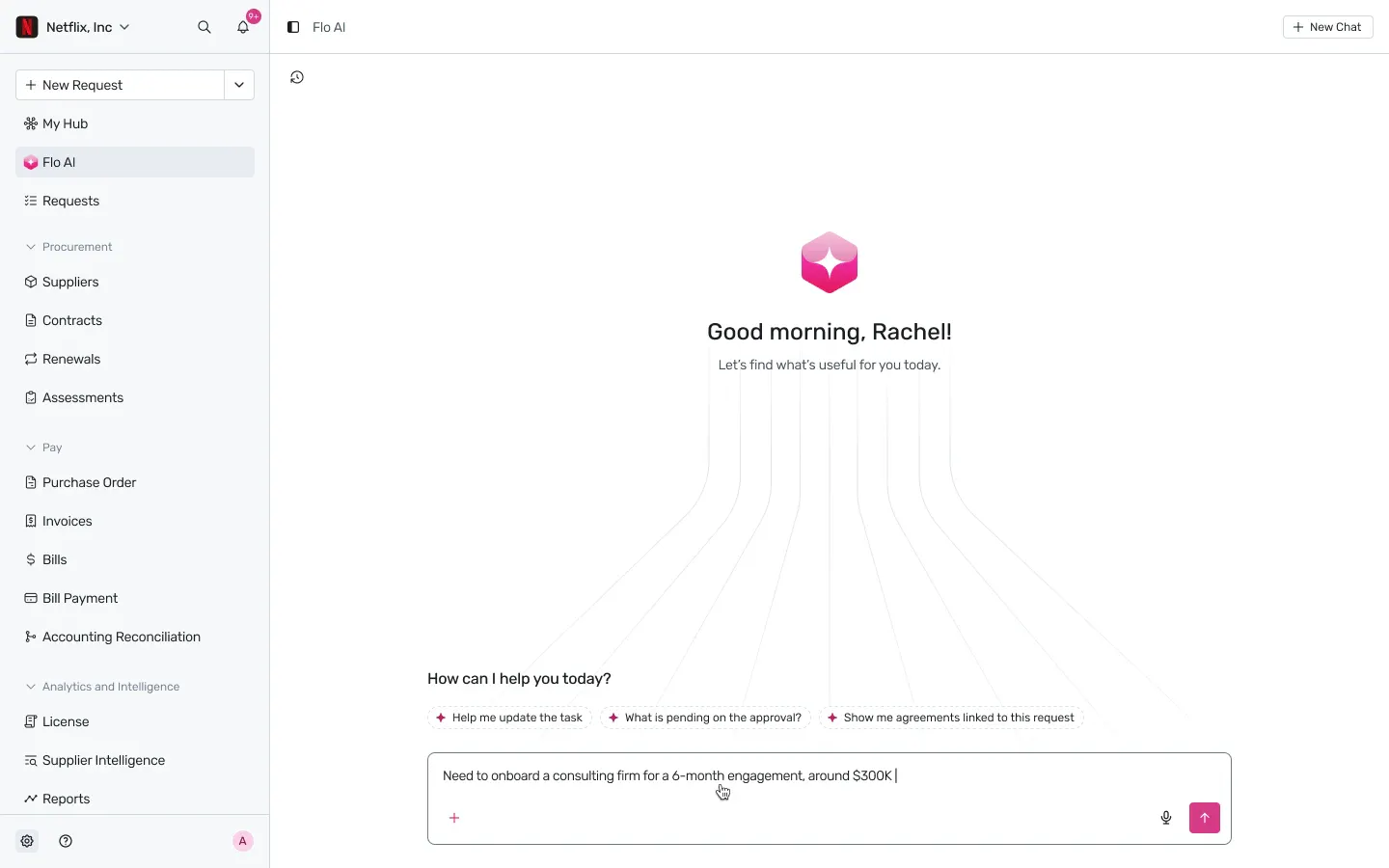
You can ask Flo questions from anywhere in the platform or in Slack and build your own agents in Agent Studio, with drafts, version history, and a shared library of company policies.
Flo works inside guardrails. Spendflo says it "never moves money or commits spend without the right human signing off”, and every step is logged. For technical teams, the help centre even documents an MCP server for connecting Spendflo to AI assistants like Claude.
However, this feature is fairly new; we found no customer reviews describing Flo in use yet; and most of it sits on Scale and move. Ask for a demo on your own contracts before you pay for a higher plan to get it.
For companies that are introducing AI into procurement, the important questions are whether the agents work reliably with existing data, which actions require approval, and what additional configuration is necessary.
Accounts payable
Spendflo now reaches all the way to payment. Its AP module reads invoices, matches them against purchase orders and contracts, routes bills for approval, and exports payment files, syncing with NetSuite along the way.
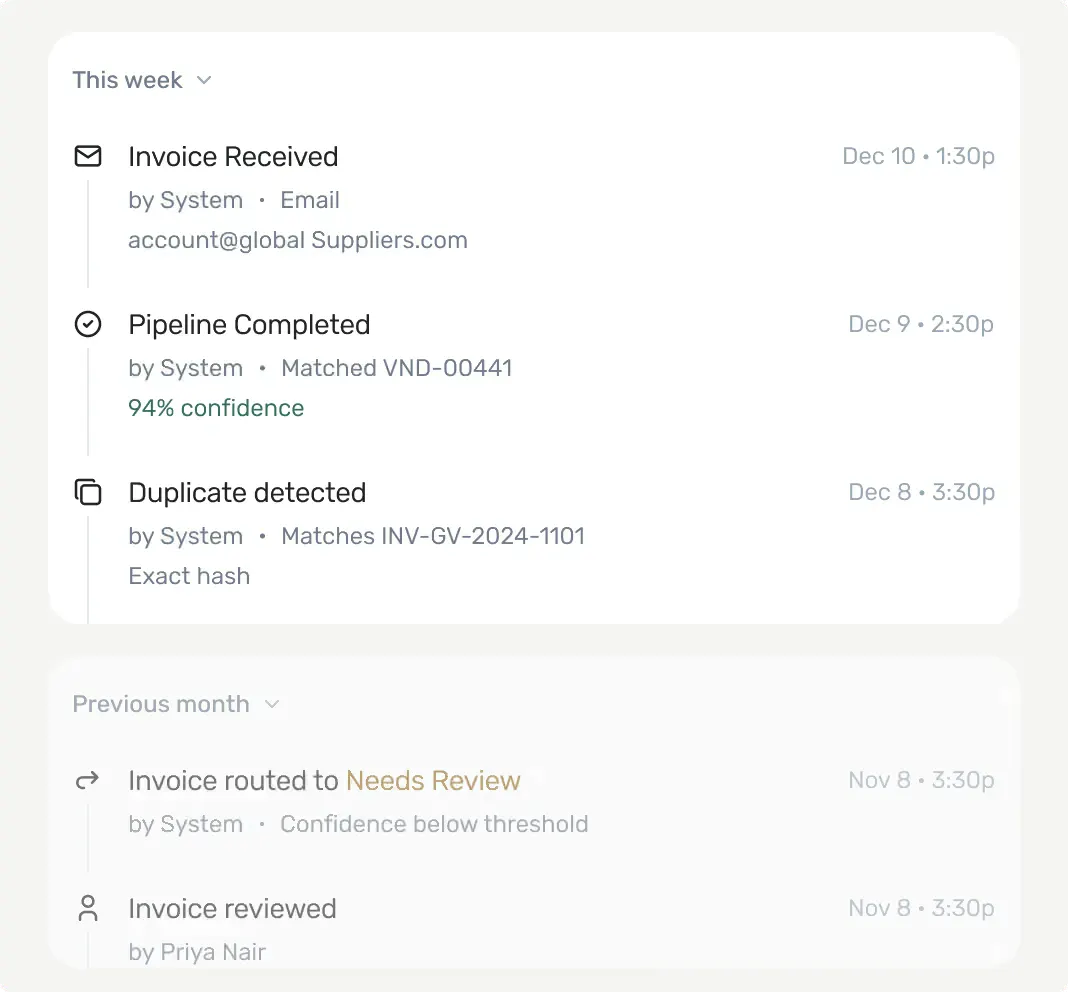
This connects your purchasing and payment in one system, so mismatches surface before money leave. However, the whole AP suite is an add-on on every plan, and its integrations centre on NetSuite.
If you don’t use NetSuite, confirm how bills and payments will sync with your ERP before you add AP to your contract.
Reporting and analytics
Every plan includes pre-built reports on spend, SLA performance, shadow IT, duplicate tools, and upcoming renewals, which you can export to PDF, Excel, or CSV.
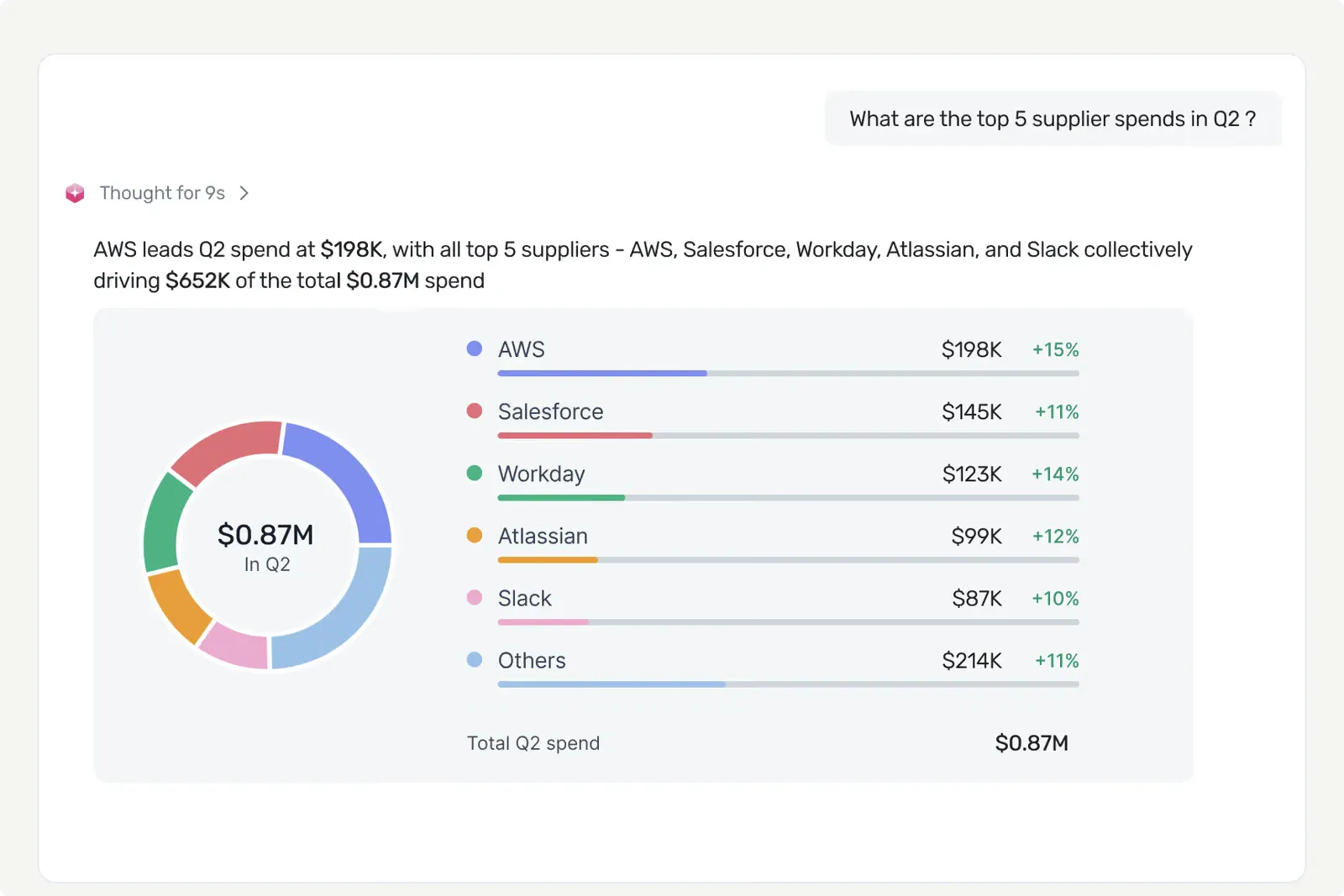
Spendflo's site also shows Flo writing plain-English summaries of reports on request. That’s useful for reports out of the box, but customer dashboards are still marked as “coming soon” on every plan.
Integrations
Spendflo connects to ERPs (with NetSuite best documented), Okta, Jira, ServiceNow, Ironclad, DocuSign, Slack, Microsoft Teams, Google Workspace, Microsoft 365, and HR systems. All integrations are available on every plan.
The coverage of US finance and IT stack is fairly strong, but European accounting tools like DATEV, Pennylane, or Exact don’t appear in its integration list.
How much does Spendflo cost?
Spendflo doesn't publish fixed subscription prices. Instead, it sells three quote-based plans (Grow, Scale, and Enterprise) using a platform fee plus charges tied to completed procurement requests.
Its pricing page lists 1,000 included requests per year, with additional charges depending on the agreed terms and spend tier.
We’ve pulled the most important differences from its full feature comparison into one table.
Grow | Scale | Enterprise | |
|---|---|---|---|
Built for | Teams with no procurement function | Teams that want AI agents and deeper controls | Full intake-to-pay run by Flo |
Intake, workflows, SLA tracking | ✓ | ✓ | ✓ |
Supplier records and pricing benchmarks | ✓ | ✓ | ✓ |
AI contract ingestion and renewal alerts | ✓ | ✓ | ✓ |
AI contract review and risk clause detection | ✗ | ✓ | ✓ |
Flo Copilot and pre-built AI agents | ✗ | ✓ | ✓ |
Custom AI agents | Add-on | Up to 5 | Up to 10 |
Global contract search and Ask AI | ✗ | ✗ | ✓ |
Supplier portal and security assessments | Add-on | Add-on | Add-on |
Accounts payable (invoices, bills, payments) | Add-on | Add-on | Add-on |
Support | Dedicated onboarding, live in 14 days | Named CSM | Dedicated migration team and senior CSM |
First, negotiation isn’t in any plan. The feature table doesn't mention it at all. According to Spendflo's terms, negotiation support is an add-on "Service" specified in your order form, and it's where the savings guarantee applies. So budget for the platform and the service separately.
Second, a lot sits behind add-ons. The supplier portal, security questionnaires, and the entire accounts payable suite cost extra on every plan.
What does it cost in practice? No public price exists, but G2's user averages give you a feel: customers rate Spendflo 4 out of 5 on perceived cost, report an average 16% discount when buying, take around one month to implement, and see a return on investment in about six months.
Spendflo also claims to be "the only procurement platform with outcome-based pricing”. In reality, other negotiation platforms, including Najar, also back their fees with savings guarantees.
How does Spendflo’s savings guarantee work?
The guarantee is Spendflo's biggest selling point, and one reviewer on Capterra named it as the reason they signed.
It's written into Spendflo's terms, but it works differently from what most people assume, so here's how it actually works, clause by clause.
- You get a proportional refund, not the full difference.
If savings fall short, you get back the same percentage of your fee as the percentage you missed by.
According to Spendflo’s own example, with a $50,000 fee and a $100,000 guarantee, delivering $75,000 in savings (a 25% shortfall) gets you $12,500 back. The refund can never exceed what you paid.
- You have to send at least 75% of your spend through Spendflo.
If you negotiate some renewals yourself, the guarantee shrinks in proportion. If you drop below 75% of the software spend in your order form, it disappears completely.
- Savings are measured against the vendor’s first quote.
This is important. If a vendor proposes a price rise, the higher price becomes the starting point.
For example, say you pay $100,000 for a tool. At renewal, the vendor asks for $120,000. Spendflo negotiates it back to $100,000. Under the terms, that’s $20,000 in savings, even though you’re paying exactly what you paid last year.
This is a standard practice in the industry, and it’s usually called cost avoidance, as stopping a price hike is valuable.
- Waived fees and freebies count too.
Partner credits, extra licences at no cost, and waived charges all count as savings, as do tools you cancel on Spendflo's recommendation.
- You have five business days to dispute a figure.
Once a vendor contract is signed, you have five business days to challenge Spendflo's savings calculation. After that, the number is final.
Patricia C., a Capterra reviewer, wished Spendflo uploaded “original quotes and proposals” alongside its notes for a clearer audit trail. With a five-day dispute window, ask for the original quote on every deal before it’s signed.
What to know before you sign with Spendflo
Beyond features and price, three details in Spendflo's legal documents are worth reading before you commit.
1. Your data is stored in the US
According to its Data Processing Agreement, updated in August 2026, Spendflo hosts customer data on AWS in Ohio, USA, and its Indian subsidiary in Chennai helps process it.
AI features run through OpenAI, Google Gemini, Anthropic Claude, and Llama Index, all listed as US-based.
To its credit, Spendflo says your data isn't used to train AI models, you can opt out of specific AI features, and it holds ISO 27001 and SOC 2 Type 2 certifications.
European transfers are covered by standard contractual clauses under Irish law. But if your company needs EU data residency, Spendflo doesn't offer it.
2. Your fee can go up mid-contract, but not down
Under its Terms of Use, moving up a contract tier during your term raises your fee automatically. Moving down only happens at renewal, with a new order form.
3. Disputes go to California
Spendflo's terms are governed by California law, with disputes settled by arbitration in San Francisco. After you leave, it keeps your data for 30 days so you can export it.
What do users think of Spendflo?
Spendflo scores well on both G2 (4.6/5 from 140+ reviews) and Capterra (4.7/5 from 50+ reviews).
Pros | Cons |
|---|---|
A negotiation team that feels like part of yours | The platform takes training to use well |
You stop missing renewal deadlines | Results depend on which executive you get |
Savings that often exceed the fee | Account managers changed often for some customers |
Fast, responsive support | Savings may occasionally not meet your expectations |
Here are the biggest trends we found in the reviews.
Spendflo Pros
The most liked Spendflo features are a team that works like your own and never getting caught off guard by renewals.
The most consistent praise concerns Spendflo's procurement specialists rather than the software itself. Rosa L., for example, commended the team's responsiveness and said it felt like working with an extension of her own department.
“The procurement team is the standout. They are aligned, proactive, and genuinely feel like an extension of our internal team.”
Customers also mention that they no longer miss deadlines or get caught by auto-renewals because Spendflo tracks every date and starts negotiating early.
Cons
Many reviewers describe the software as useful but not intuitive, with a learning curve for new users. Your experience also depends on who you get.
“The product itself still feels like it's maturing. Some workflows and features don't always work as expected.”
Caitlin specifically highlighted the training required to gain the insights you need from an overall company perspective, noting the platform isn't the most intuitive to use and requires upfront training.
And, because the service is so central, the experience varies with your team. Several reviewers mention inconsistency between executives.
“It depends a lot on the account executive you get, the consistency varies”
Some had to just to changing contacts during onboarding. For example, Rita P., a senior accountant reviewing Spendflo on Capterra, noted that her team had a lot of changes in account managers and procurement specialists, which was hard to follow.
Finally, most reviewers report savings, but not all. One G2 user said savings “haven’t been as material as we initially hoped,” while fairly adding that SaaS market conditions play a part.
So set expectations and agree on how savings will be measured before you start.
Najar as a Spendflo alternative for European businesses
For businesses based in Europe, Najar is another platform worth comparing with Spendflo.
Both combine procurement software with negotiation expertise, but they have different regional focuses and product priorities.
Najar | Spendflo | |
|---|---|---|
Based in | Paris, France | San Francisco, USA |
Data hosting | EU native | US (AWS Ohio) |
Focus | Indirect procurement, mostly IT and software | Software, expanding into intake-to-pay and AP |
Human negotiators | Dedicated IT buyers | Managed procurement pod |
AI | AI features (contract extraction, AI request copilot), no agents | Flo AI agents and custom agents (Scale and above) |
Pricing model | Annual flat fee + savings guarantee | Tiered plans + add-ons, negotiation sold as a service |
If savings fall short | Proportional refund of the service fee | Proportional refund, if 75% of spend is routed through Spendflo |
Setup | About 10 days | 14 days (Grow), around 1 month on average (G2) |
Accounting integrations | DATEV, Pennylane, Exact, Cegid, Visma, NetSuite, Dynamics 365 BC | NetSuite, Coupa, plus Okta, Jira, Ironclad, DocuSign |
G2 rating | 4.6/5 (45+ reviews) | 4.6/5 (140+ reviews) |
Spendflo has developed more extensive dedicated agent functionality through Flo, which might be useful for companies prioritising AI-led intake and accounts payable workflows. Meanwhile, Najar focuses on indirect procurement and supplier negotiations for European businesses, with EU hosting and integrations relevant to regional finance teams.
When picking between Spendflo alternatives, factor in your location, existing systems, procurement needs, and the level of negotiation support required.
Our verdict on Spendflo
Spendflo is a viable choice for US mid-sized companies that want someone to negotiate their software contracts and a modern platform to run purchasing.
It covers several procurement functions, but its value depends on which services your organisation needs and how much the complete arrangement costs.
However, make sure you can stomach the the learning curve and the conditional savings guarantee, and before signing, confirm the cost of managed negotiation, how savings are calculated, and which services are included in your quote.
If you're a European company that wants the same combination of software and expert negotiators, with your data kept in the EU, we'd love to show you how Najar works.
Benchmark one of your upcoming renewals to see the difference before committing to anything.
Frequently Asked Questions (FAQs)
Is Spendflo worth it?
Spendflo may be worthwhile for businesses that need help managing software contracts and don't have a dedicated procurement team.
However, you’ll need to carefully check the total cost and savings guarantee conditions. Its value will depend on how much procurement work your company routes through Spendflo, which services are included, and whether the results justify the fees.
How much does Spendflo cost?
Spendflo doesn't publish prices. Its three plans (Grow, Scale, and Enterprise) are quoted individually, and features like accounts payable, the supplier portal, and managed negotiation cost extra.
G2 users rate its cost 4 out of 5, meaning it sits at the higher end.
Does Spendflo guarantee savings?
It can, if the guarantee is written into your order form. If savings fall short, you get a proportional refund of your fee, but only if you route at least 75% of the agreed spend through Spendflo's negotiation service.
Where does Spendflo store data?
Spendflo hosts customer data in the US, on AWS in Ohio, according to its Data Processing Agreement.
It's GDPR compliant and uses standard contractual clauses for European transfers, but it doesn't offer EU data residency.