
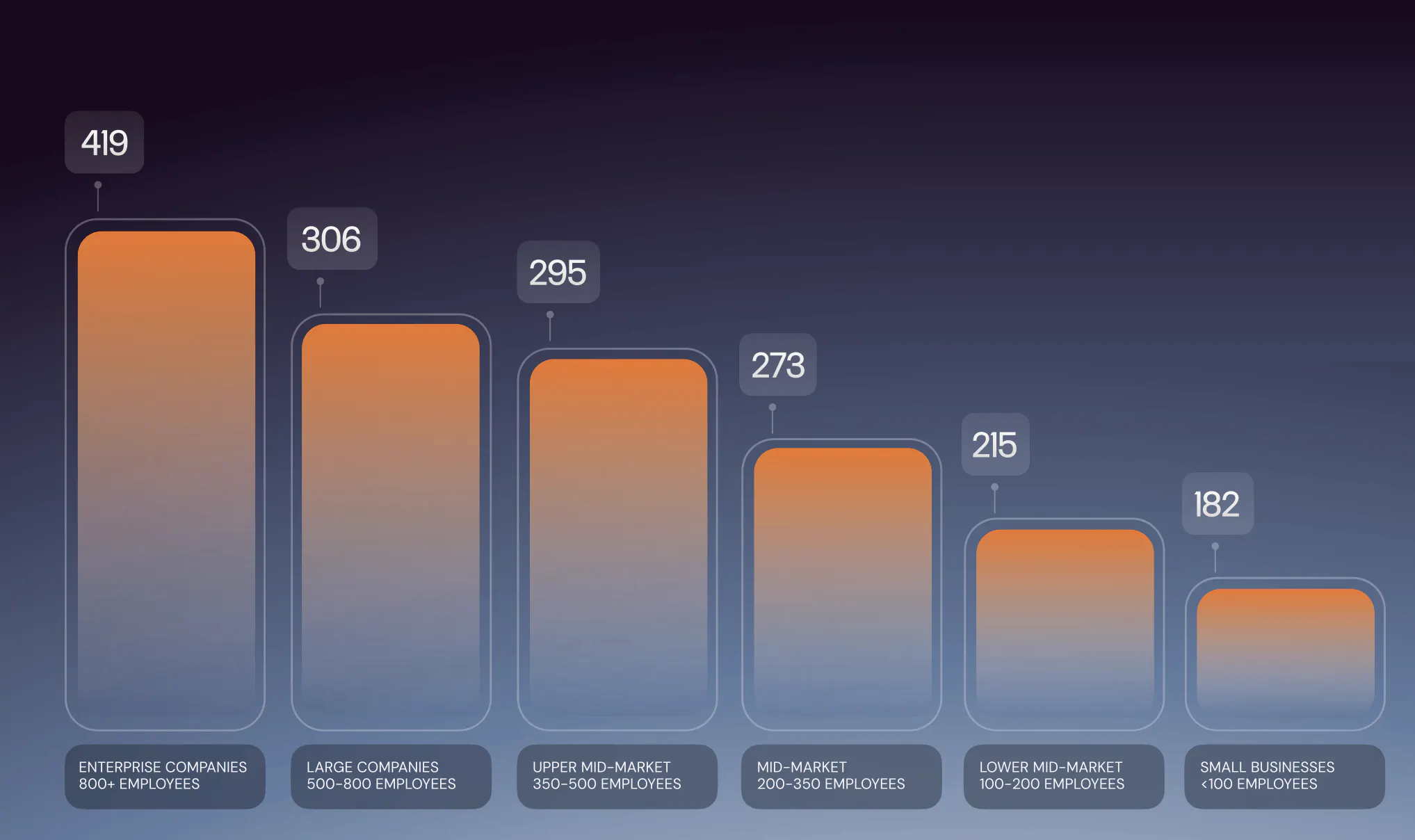
According to Najar’s 2025 SaaS Trends Report, European companies with fewer than 100 employees used an average of 182 SaaS tools in 2025, and companies with 800 or more employees averaged 419. The report draws on real usage data from over 180 European companies, all Najar customers.
For a procurement lead, the count is only the start. The harder questions are which teams rely on which tools, and how much of the stack you actually manage.
How many SaaS tools does a company your size use?
Companies under 100 employees averaged 182 tools, rising to 215 at 100 to 200 employees and 273 at 200 to 350. Growth then slows, to 295 tools at 350 to 500 employees and 306 at 500 to 800, before enterprises with 800 or more employees reach 419.
Why does a small company run 182 tools?
The number looks high for a small team, but there’s a reason behind it.
“The number can seem surprisingly high for companies under 100 employees, but it's important to keep in mind that this often includes free tools or shadow IT that we identified through SSO. It's a reminder of how much software lives outside official Procurement channels.”
In other words, part of your stack may sit outside the contracts you manage, and it still needs to be counted.
Which tools does each team rely on?
The report identifies the tool categories companies treat as essential, based on the highest adoption rates within each industry. Grouped by team, they cover the following.
- Engineering relies on version control, cloud infrastructure and monitoring, with project management tools for task management, agile work and workflow automation.
- For sales and marketing, the core is CRM, analytics and marketing automation. Retail and eCommerce teams add email marketing, campaign management and personalisation.
- Customer support runs on helpdesk software, chat tools and feedback management.
- Security and compliance depend on identity and access management and security monitoring, and fintech adds identity verification, fraud detection and regulatory compliance tools.
- Collaboration tools for team messaging, video conferencing and document sharing are core in every sector.
In fintech, payment processing, transaction monitoring and business intelligence tools for analytics, reporting and data visualisation complete the core.
Which AI tools do teams use?
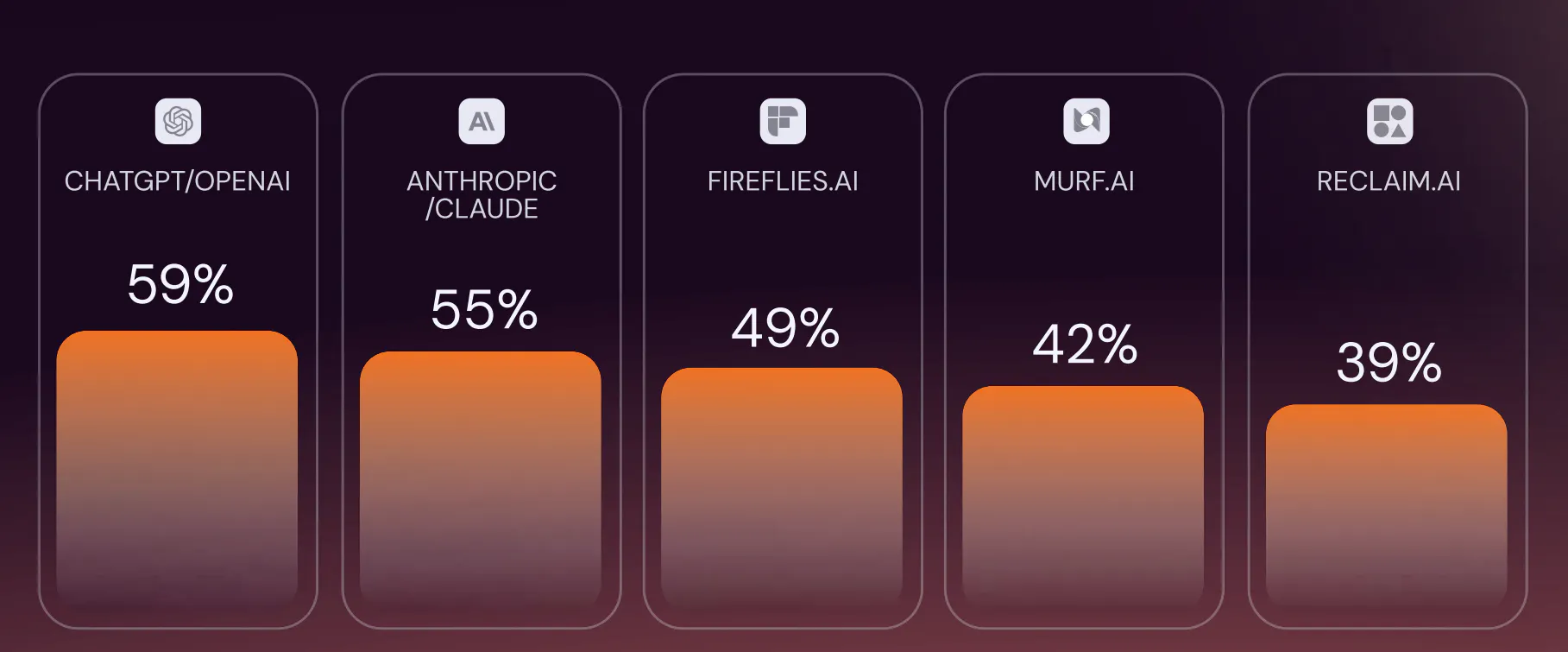
Five AI tools stood out across the companies in the report. ChatGPT/OpenAI was used by 59% of companies and Claude by 55%. These chat-based assistants are now embedded across teams, from legal to marketing and from product to customer service, because they help people write, summarise, draft and decide faster.
The other three serve narrower needs. Fireflies (49%) and Reclaim (39%) power calendar coordination, meeting follow-ups and productivity hygiene, especially in hybrid teams, while Murf (42%) speeds up marketing and content production.
Large enterprises are also turning to AI built into the suites they already use.
“Across the large enterprises we work with at TOLSON, there is a clear trend toward adopting GenAI tools embedded in existing office ecosystems, such as Microsoft Copilot or Google Gemini.”
Before buying a new AI tool, check what's already included in the contracts you hold.
How do you cut back?
Procurement-enabled teams that take a structured, data-led approach to SaaS can save up to 36% on software spend, according to the report. The approach runs in three phases. First, see clearly by auditing the full stack, mapping renewals and spotting redundancies. Next, set the rules on who buys, who approves and which tools belong in the core stack. Then eliminate overlaps, renegotiate contracts, centralise management and keep refining your SaaS strategy each quarter.
For the savings to last, the way your company buys software has to change too.
“SaaS purchases need a robust, tooled governance and a perfect internal cross-stakeholders alignment!”
With Najar, a dedicated SaaS buyer works from a complete inventory of your tools, their usage and their costs to find savings like inactive licences and redundancies, then supports you on new purchases and renewals. For what companies your size spend each year, see What is a normal SaaS spend for a company your size?.
Get the full 2025 SaaS Trends Report
Frequently asked questions
How many SaaS tools does a company with 100 employees use?
Companies under 100 employees averaged 182 tools in Najar's 2025 data, and those with 100 to 200 employees averaged 215.
What percentage of companies use ChatGPT?
59% of the European companies in Najar's 2025 dataset used ChatGPT/OpenAI.