
About 30-40% of enterprise IT spending occurs without official IT oversight. This often means teams buy their own software, auto-renewals go unnoticed, and some expenses get buried in spreadsheets.
This is called Shadow IT.
Because of it, many organizations are now using SaaS management platforms to better track their software and manage costs.
Vendr is a popular procurement solution, but the right choice for your team depends on your size, budget, support needs, and whether you need to manage more than just software.
Platforms such as Najar, Vertice, Ramp, and Spendflo each handle procurement differently. Here’s how they compare.
What Is Vendr?
Vendr is a SaaS procurement platform built to help finance and procurement teams buy software more efficiently.
It provides pricing benchmarks, negotiation support, and contract analysis, so teams know what fair pricing looks like before sitting down with a vendor.
Vendr plans cost between $12,000 and $120,000 per year. For large organizations with big SaaS budgets, this investment might be worthwhile. For smaller teams, it’s reasonable to ask if the cost is worth the benefits.
Vendr mainly serves the North American market and focuses on SaaS instead of broader indirect spending. It also relies more on self-serve tools than on direct expert support.
If these limitations are important to your team, one of the Vendr alternatives below might suit you better.
6 Best Vendr Alternatives
1. Najar – Best All-in-One SaaS Procurement Platform
Ratings ⭐⭐⭐⭐⭐
G2 4.6/5 (36) Capterra 4.9/5 (22) FeaturedCustomers 4.8/5.0 (426)
Pricing: Contact Najar for a demo and personalized quote.
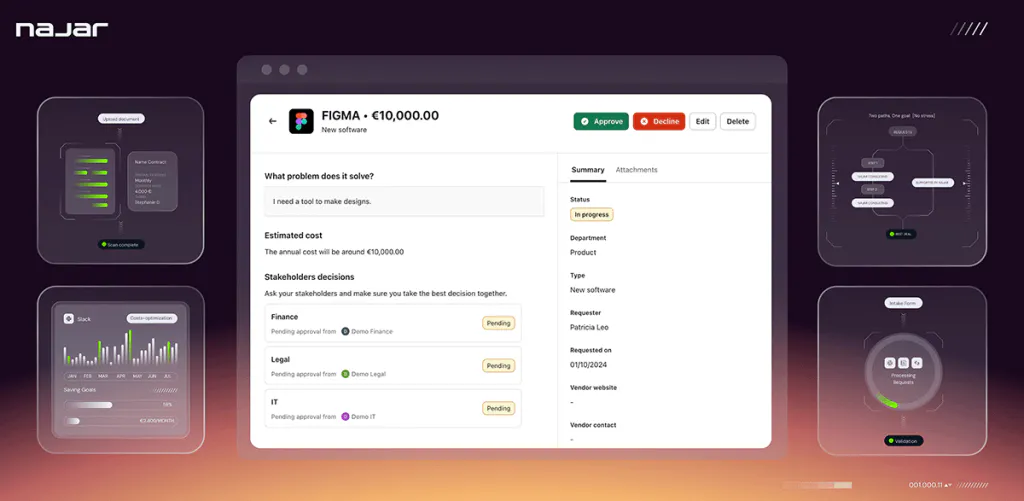
While Vendr relies on its pricing database and self-serve tools, Najar combines technology with a team of IT buyers who support clients from start to finish.
Najar automatically surfaces inefficiencies, duplicate subscriptions, shadow IT activity, and renewal risks, so you always have full visibility and control.
Najar stands out by offering full negotiation support as a standard feature, not as an extra. Clients have reported saving up to 36% on contracts, with some seeing savings over 45%.
At Najar, we go beyond negotiation by supporting the entire procurement process.
The platform handles SaaS discovery, spend tracking, purchase requests, approval workflows, vendor sourcing, contract management, supplier intelligence, collaborative decision-making, and AI-driven insights in one platform.
It's a strong fit for mid-market teams and enterprises seeking procurement, governance, and savings in one platform, without building an in-house team from scratch.
Features:
- Complete SaaS discovery and inventory across the organization
- Usage and spend tracking to surface waste and redundancy
- Smart purchase requests with automated routing and approvals
- Collaborative procurement hub for stakeholder alignment
- Vendor sourcing and negotiation support backed by expert IT buyers
- Contract and renewal management with automated alerts
- AI-powered benchmarking, forecasting, and recommendations
Cons
Platform is still maturing; some features are newer additions
Requires integrations to unlock full value
Primarily operates in Europe; less suited for global organizations
Pros
Guaranteed savings, not just a promise
Human expert buyers included as standard, not upsold
Strong visibility across shadow IT, spend, and usage
Covers both software and broader indirect spend
Intuitive enough that teams can get value from day one
2. Sastrify
Ratings ⭐⭐⭐⭐⭐
G2 4.5/5 (87) FeaturedCustomers 4.8/5.0 (1306)
Pricing: Modular pricing. Software Management starts from €12.5k/year; Expert Procurement from €25k/year.
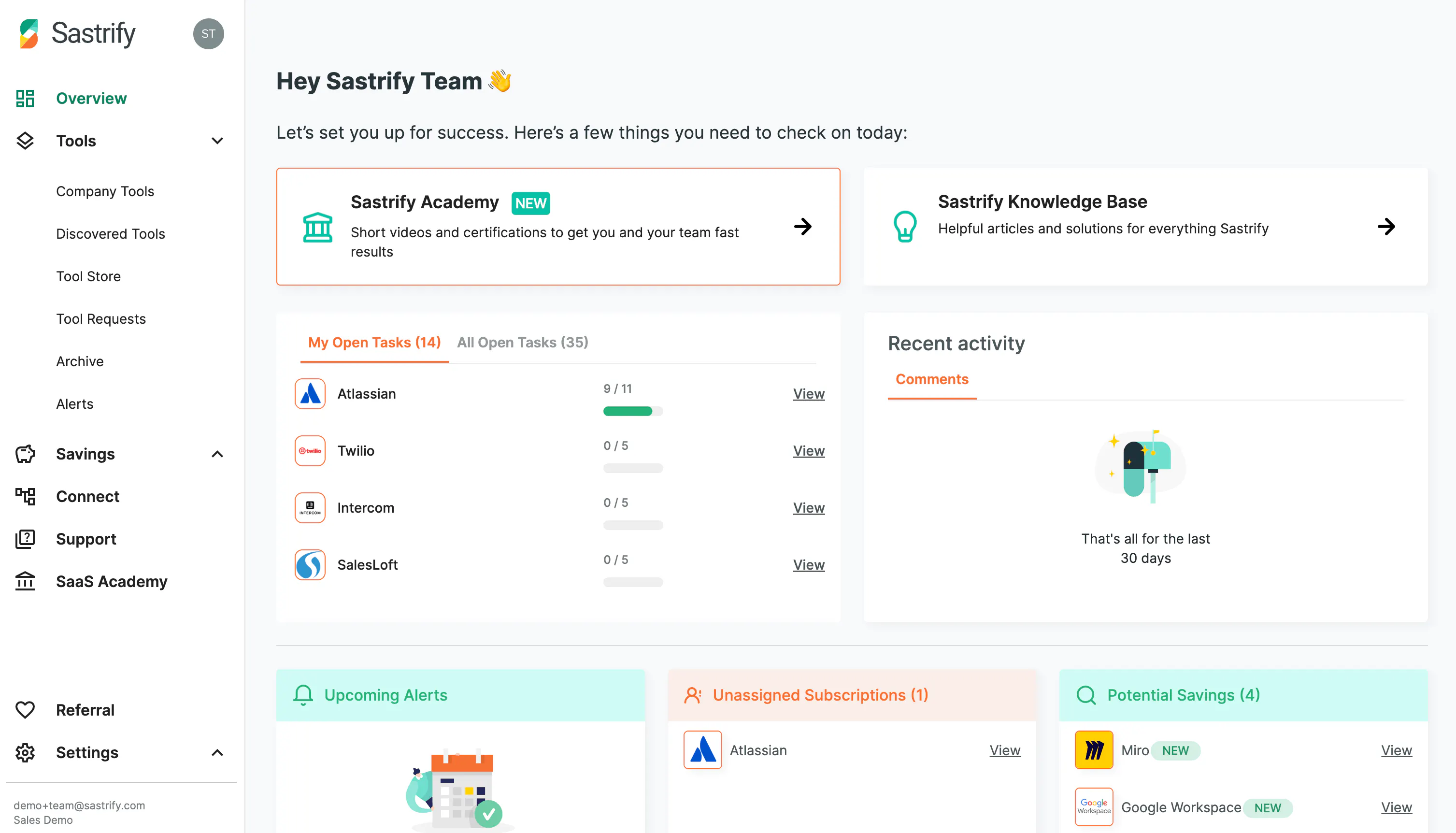
Sastrify is an AI-powered platform designed to simplify software management and SaaS procurement by bringing your entire stack into one centralized dashboard.
It integrates with identity providers, browsers, and ERP tools to automatically detect all the applications your company uses. From there, it organizes key data like ownership, usage patterns, renewal timelines, and overall spend into a single, clear inventory.
The platform is particularly well-suited for companies operating in the EMEA region, with support adapted to local compliance requirements and vendor ecosystems.
Beyond visibility, Sastrify also offers hands-on procurement support through dedicated customer success managers. With its SastriMarket feature, teams can benefit from pre-negotiated deals and discounts with various vendors.
Implementation is quick and straightforward, allowing teams to get up and running in just a few minutes.
Features:
- Renewal management: Automated alerts for notice periods and contract end dates.
- Market price benchmarking: Data-driven insights for competitive vendor negotiations.
- SaaS spending visibility: Real-time dashboards tracking spend by vendor and department.
- Collaboration hub: Tools for stakeholders to communicate on upcoming renewals.
- Vendor discovery: Insights into alternative tools to help with software consolidation.
- SastriMarket for fast access to pre-negotiated deals
Cons
Some users find the interface confusing
No API is available, so deep customization is limited
Setting up the tool can take time because of the initial data entry required
Pros
Fast setup, live in minutes, not weeks
Cuts approval cycle times by 60%+
Strong presence in the DACH region
3. Vertice
Ratings ⭐⭐⭐⭐⭐
G2 4.6/5 (238)
Pricing: Fixed annual subscription based on your annual SaaS spend. Custom quotes available upon demo request.
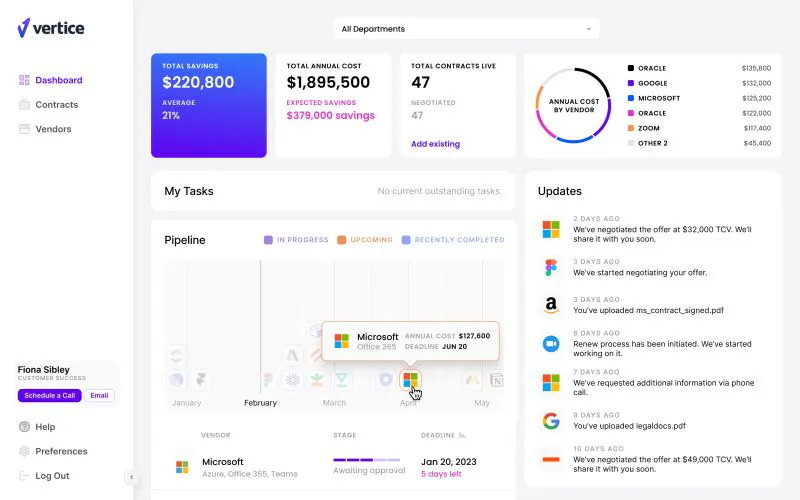
Vendr mainly focuses on SaaS. Vertice does that as well, but it stands out as the only major platform that combines SaaS and cloud spend, AWS, Azure, and Google Cloud, into a single unified dashboard.
Finance teams who are tired of managing separate invoices and contracts may find this integration reason enough to make the switch.
Vertice supports the entire procurement process, starting with purchase requests and continuing through vendor selection, negotiation, and contract signing.
Its AI agents manage over 70 procurement tasks, including compliance checks and pricing benchmarks.
Vertice is designed for mid-market and enterprise teams looking for structured workflows, solid benchmarking data, and direct negotiation support. It also offers cloud cost visibility, which is unique among these platforms.
→ 💻 Looking for more options? Check out our comparison of the top 7 Vertice alternatives to find the best fit for your procurement and SaaS spend management needs.
Features:
- Cloud cost optimization for AWS, Azure, and Google Cloud
- Spend benchmarking with real-time market pricing data
- Renewal workflow automation and contract tracking
- Vendor management dashboard with financial impact view
- AI-driven spend forecasting
Cons
Some workflows still require manual steps
Pricing scales with SaaS spend, which can be expensive for smaller teams
Dashboard can be slow when loading large datasets
Pros
The only platform combining SaaS and cloud spend in one dashboard
Clean interface that requires almost no training
Integrates with CLM, ERP, TPRM, and SSO tools
Users report identifying savings within days of setup
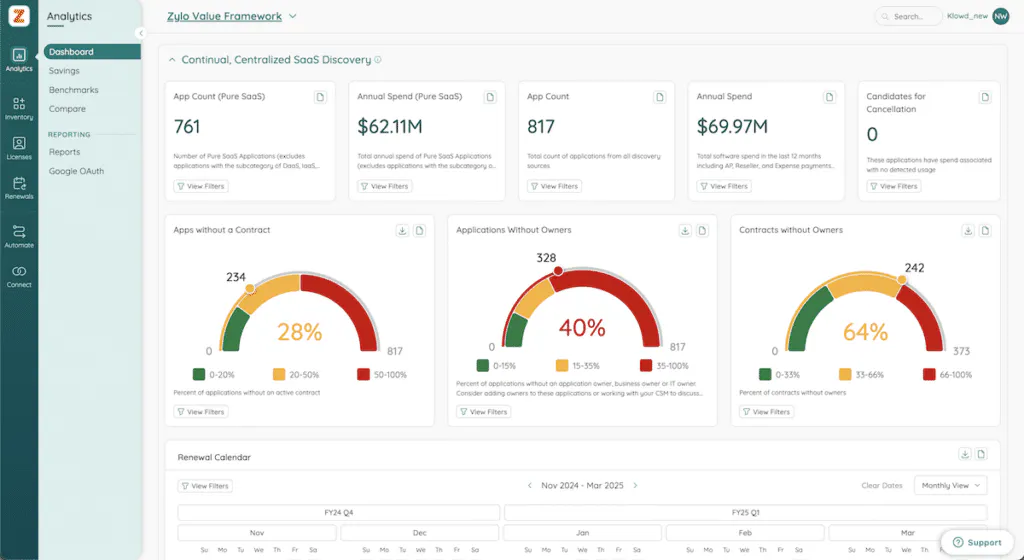
Vendr presents itself mainly as a procurement and negotiation tool. Zylo, on the other hand, is an enterprise-grade SaaS management platform and has been named a Leader in the 2024 and 2025 Gartner Magic Quadrant for SaaS Management Platforms.
Zylo focuses less on managed negotiation and more on giving large IT, SAM, and procurement teams full visibility and control over complex software portfolios.
Its AI-powered discovery engine finds every application in use, even those bought with personal cards or outside IT’s control, and matches them to a library of over 20,000 applications.
Customers typically see a sixfold return on investment, with cost savings of 10 to 20 percent through license reclamation and renewal optimization.
If Vendr helps you buy and negotiate software, Zylo helps you fully understand and manage the software you already own.
Cons
Enterprise pricing puts it out of reach for smaller teams
Data accuracy depends on proper integration setup
Less suited to teams primarily seeking managed negotiation
Limited European presence and multilingual support
Pros
Gartner-recognized leader in SaaS management
Deep benchmarking from $40B+ in spend under management
Comprehensive discovery including shadow IT
Customizable workflows for complex enterprise governance
5. Zluri
Ratings ⭐⭐⭐⭐⭐
G2 4.6/5 (177)
Gartner 4.6/5 (73)
Pricing: Zluri has a flexible pricing model based on employee count. Plans start at about $4-$8 per user per month for their core SaaS management platform. The pricing includes Standard, Professional, and Enterprise options. Higher tiers include additional features such as advanced automation, custom integrations, and dedicated support.
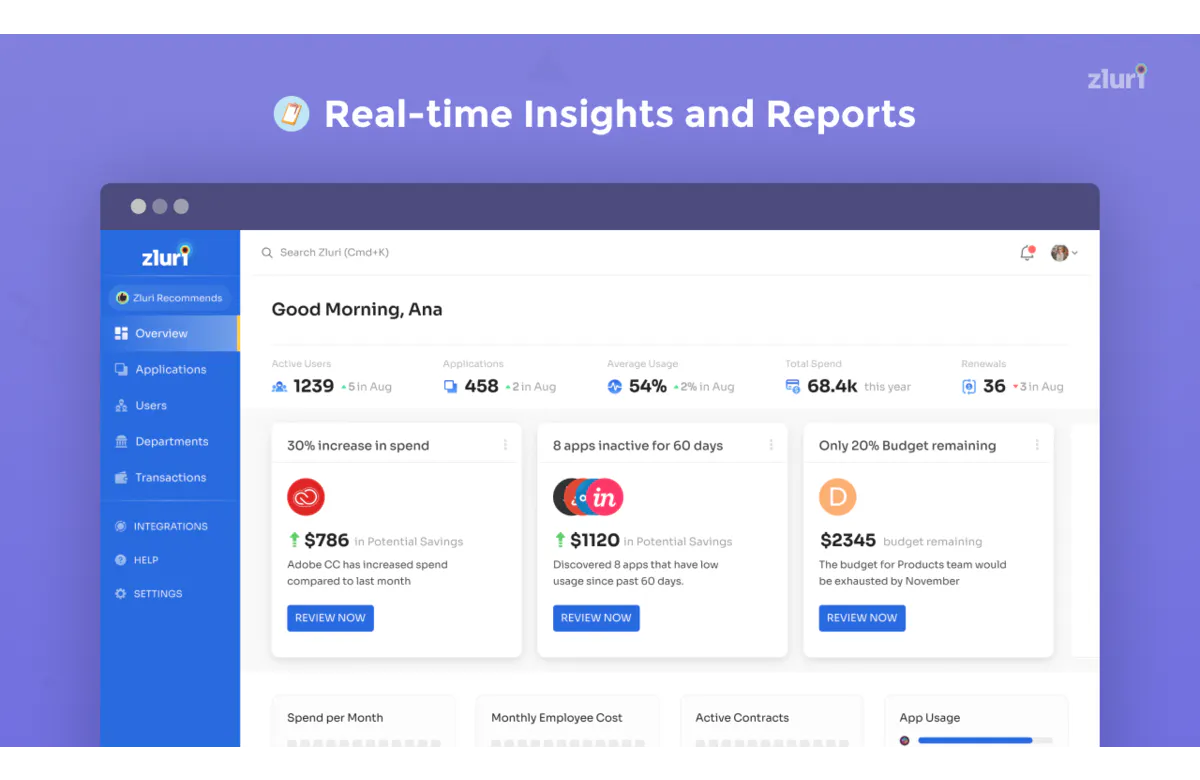
Vendr is designed for finance and procurement teams, while Zluri is made for IT and security teams. This difference is important.
Rather than focusing primarily on spend optimization and vendor negotiation, Zluri combines SaaS management with Identity Governance and Administration (IGA), making it the right choice when access control, compliance, and user lifecycle management are just as important as cost.
Its patented nine-method discovery engine finds every application used in the organization. It also automates workflows for new hires, role changes, and departures, so software access is managed automatically.
For IT teams handling hundreds of applications and thousands of users, this offers a very different value than Vendr.
Features:
- Patented 9-method SaaS discovery engine
- Automated access reviews and user provisioning/deprovisioning
- License optimisation with inactive user detection
- Compliance tooling for SOX, HIPAA, and SOC 2
- Multi source discovery via IDP, browser agent, and financial integrations
Cons
Setup can take several weeks
More expensive for mid-market companies
Some direct integrations can be unreliable
Analytics dashboards can lag on updates
Pros
Powerful app discovery across all procurement channels
Intuitive interface
Strong identity governance capabilities alongside cost optimization
6. Spendflo
Ratings ⭐⭐⭐⭐⭐
G2 4.6/5 (143)Software Advice 4.7 (55)
Pricing: Custom. Contact Spendflo for a demo and pricing tailored to your organization’s size and SaaS spend.

Spendflo takes a different approach, meeting teams where they already work.
With strong Slack and Microsoft Teams integration, employees can submit purchase requests, get approvals, and track renewals right from their chat tools.
This focus on reducing friction is especially helpful for companies where procurement delays are caused by internal processes, not vendor issues. Spendflo’s expert buyers handle vendor negotiations for you, and its AI document intelligence automatically processes contracts and usage data.
→ 💻 If Spendflo isn't quite the right fit, see our breakdown of the 9 best Spendflo alternatives for SaaS spend management.
Features:
- AI-powered document intelligence and usage tracking
- Automated intake to procure workflows with no code customization
- Slack and Microsoft Teams integration for approvals and requests
- Expert negotiation support from in house procurement specialists
- Deep ERP integrations including NetSuite
Cons
Response times can be inconsistent across accounts
Reporting and dashboard features are limited
Few suggestions for alternative apps within the platform
Pros
Strong negotiation track record
Deep ERP integrations including NetSuite
Intuitive UI with consistently positive user reviews
What Alternatives to Vendr Should Deliver For Your Business?
It only makes sense to switch procurement platforms if the new one solves problems your current tool can’t. Here are some things to look for, no matter which platform you pick.
1. Full spend visibility, not just a dashboard
Every procurement platform should show you what you’re spending. But it’s even more important to know why you’re spending it and what actions you can take.
Choose tools that reveal software employees have added on their own, not just what’s officially approved. The best platforms show who uses each tool, when renewals are due, and where compliance risks could be. These details help procurement teams act before problems arise.
2. Guaranteed savings, not just promises
Any platform can promise ROI in a sales pitch, but few put it in writing. When you compare options, ask if savings are guaranteed and what happens if they aren’t.
For example, Najar guarantees savings in their contracts, supported by over $2 billion in spend data.
Explore Real Customer Stories
3. Expert human buyers, not just software
Benchmarking data can show you what you should pay, but it won’t negotiate on your behalf. For complex or expensive contracts, having someone to handle negotiations is important.
Some platforms, such as Najar, include a team of IT procurement specialists who negotiate for you as part of their standard service, not as an extra.
One Najar user negotiated a contract down by 45% instead of the original 15% target, thanks to direct access to professional buyers. Since not all platforms offer this, it’s important to ask how involved their support team will be before you decide.
4. A procurement process that scales with your team
A tool that works for 50 employees might not work for 500. As your company grows, you need processes that scale too. Clear request and approval workflows should capture budget, vendor, and use case details from the start, so nothing is bought informally or forgotten.
5. Contract management that actually prevents missed renewals
Auto-renewals for contracts your team no longer needs are an easy cost to avoid. Look for platforms that send early, automatic alerts, not just a reminder a week before.
Najar sends alerts 45 days before renewal deadlines through Slack or email, giving teams enough time to renegotiate, downgrade, or cancel. No matter which platform you choose, this kind of notice should be a basic feature, not an extra.
Where Najar Goes Further
Vendr and Najar overlap in meaningful ways, both offer spend tracking, contract management, spend forecasting, and SaaS utilization tracking. For teams evaluating either platform, the surface-level feature list can look similar. The differences show up in depth.
Some of these gaps are important to look at more closely.
Peer benchmarking:
- With Najar, you can compare your software costs, usage, and feedback directly with similar companies.
- Vendr also has benchmark data, but you only see it during negotiation advice, not as a feature you can check on your own.
Procurement depth:
- Najar supports the entire procurement process, including requests, approvals, supplier onboarding, compliance checks, and risk reviews.
- Vendr has fewer features here and focuses more on spend insights than managing the whole procurement workflow.
Human-led negotiation: This is the biggest difference. Vendr gives you advice on negotiations, while Najar actually handles negotiations for you with a team of buyers. For small finance teams, this can save a lot of time and, according to user reviews, often leads to bigger savings than expected.
Pricing:
- Vendr’s pricing starts at $12,000 per year.
- Najar doesn’t list a minimum price like that, and its approach focuses on delivering value quickly. Many users say they earn back the cost within their first contract cycle.
Vendr works well for bigger companies that want procurement insights and can handle their own negotiations. Najar is designed for businesses that want both the platform and expert help, which is especially helpful for mid-sized teams without their own procurement staff.