
Somewhere right now, a SaaS subscription is auto-renewing for a tool three people used twice. A laptop is sitting in a drawer, still being insured. And nobody knows about either of them.
IT asset management should take care of that.
Organizations can cut software spending by up to 30% using IT asset management best practices, and that is real money back in your budget.
In this guide is the answer to:
- What IT asset management (ITAM) actually is
- What happens when you skip Asset lifecycle management
- What best practices separate good ITAM from great ITAM
- How To Choose the right SaaS portfolio management tool
- How Najar can help with all of the above.
→ 💻 For more information about software governance, check our guide to Software Asset Management.
What is IT Asset Management (ITAM)
IT asset management is the end-to-end process of tracking, managing, and optimizing every IT asset an organization owns or uses, from the moment it is acquired to the moment it is retired.
The goal is simple: make sure every asset is accounted for, properly maintained, and not draining money it should not.
An IT asset is any piece of hardware, software, or digital resource that has value to the business. Here is how they break down:
Asset type | Examples | What to manage | Why it matters | |
|---|---|---|---|---|
Hardware | • Laptops | Location, warranty, condition, replacement cycle | Prevents loss, damage, and duplication | |
Software | • Microsoft | License count, version, usage, renewals | Avoids overspending and compliance risk | |
SaaS | • Slack | Active users, spend, duplicate subscriptions | Reduces waste and shadow IT | |
Cloud infrastructure | • AWS | Provisioning, usage, idle resources, cost | Controls cloud sprawl and overspend | |
Networking equipment | • Routers | Configuration, firmware, access control | Ensures secure and reliable connectivity | |
Mobile devices | • iPhones | Enrollment, security policies, lifecycle | Enables secure deployment and management | |
Digital assets | • Databases | Access rights, compliance, backups | Prevents data loss and security breaches |
ITAM is not reserved for large enterprises. Any organization that relies on technology, from a 20-person startup to a global corporation, benefits from having clear visibility and control over its assets.
What is The Difference Between ITAM And ITSM
IT service management (ITSM) is about managing and delivering IT services to the business: help desks, incident response, change management, and service requests.
IT asset management (ITAM) is specifically about the assets that underpin those services.
Think of ITSM as the system for managing how IT supports employees, and ITAM as the system managing the tools and assets behind those services.
When someone requests a new laptop through ITSM, ITAM makes sure that device is logged, tracked, maintained, and eventually retired properly.
ITAM | ITSM | |
|---|---|---|
Focus | Assets (hardware, software, SaaS) | Services and service delivery |
Goal | Maximize asset value, reduce waste | Deliver reliable IT services |
Scope | Procurement to retirement | End-to-end service management |
Key outputs | Asset inventory, license compliance | Incident resolution, change management |
Team | IT, Finance, Procurement | IT Operations, Support, DevOps |
They work best together. ITAM feeds accurate asset data into ITSM workflows, like knowing a device's full history when a support ticket comes in, or verifying license status before approving a change request.
Why IT Asset Management Matters for Your Business
Most organizations are hemorrhaging IT spend without a single bad decision to blame, just a lack of visibility into what they are actually paying for. ITAM fixes that. Here is what it does in practice:
- It stops you from paying for things you don't use
Unused licenses, forgotten SaaS subscriptions, and duplicate tools drain budgets every month. ITAM surfaces them before the next renewal hits. - It kills ghost assets
Hardware that is gone but still on the books costs real money in depreciation and insurance. An active inventory wipes them out. - It keeps you audit-ready
Software vendors like Microsoft and Oracle audit their customers. Without accurate license records, you are liable for fines that can far exceed the cost of the software itself. - It closes security blind spots
Untracked devices and outdated software versions are among the most common entry points for breaches. If it is not in your inventory, it is not getting patched. - It brings shadow IT into the light
When employees buy tools without IT's knowledge, both your spending and security take a hit. IBM reports that shadow IT can account for up to 40% of IT spending in large organizations. Most of that spending is invisible until something goes wrong. - It makes smarter procurement possible
When you know exactly what you own, what it costs, and when it expires, you stop making purchases based on guesswork and start making them based on data. - It supports every other IT process
Change management, incident response, compliance, and financial planning all run better when your asset data is accurate and accessible.
Every benefit ITAM delivers, whether financial, operational, or security-related, starts in the same place: knowing what you have. You cannot optimize what you cannot see.
What is The IT asset Lifecycle
Every asset follows a lifecycle from the moment it enters your organization to the moment it leaves. Managing that journey intentionally is the whole point of ITAM.
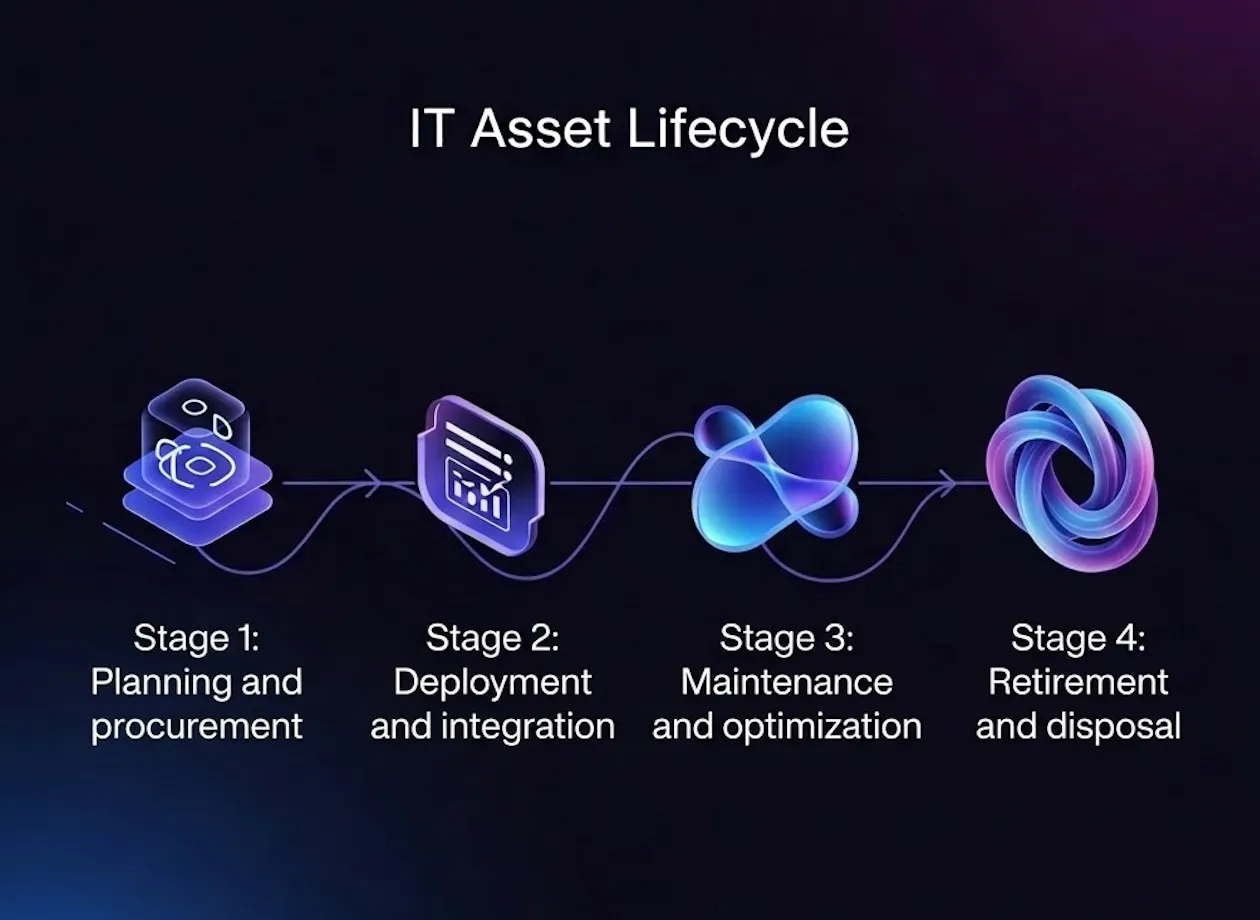
Stage 1: Planning and procurement
- Define the exact need before making any purchase.
- Compare available options based on features and fit.
- Evaluate the total cost of ownership, not just the upfront price.
Stage 2: Deployment and integration
- Set up and configure assets for immediate use.
- Assign access to the right users with proper permissions.
- Document configurations and add the asset to your tracking system from day one.
Stage 3: Maintenance and optimization
- Keep systems updated with regular patches and upgrades.
- Monitor performance to ensure assets are delivering value.
- Review licenses and manage renewals to avoid waste.
Stage 4: Retirement and disposal
- Securely wipe all data before decommissioning.
- Cancel licenses and remove the asset from active records.
- Dispose of hardware responsibly at end of life.
🔥 Note
Every benefit ITAM delivers, whether financial, operational, or security-related, starts with knowing what you have. You cannot optimize what you cannot see.
What Happens When You Skip Lifecycle Management?
Skipping lifecycle management is not a neutral choice. The consequences just show up later, usually at the worst possible time.
Ghost assets drain your budget
Assets that are lost, broken, or long gone but still on the books cost real money in depreciation, insurance, and maintenance contracts.
Compliance and audit exposure
Without clear records of asset locations, license usage, or secure data handling, your organization is exposed to fines, penalties, and regulatory problems.
Security vulnerabilities
Outdated hardware, unpatched software, and untracked assets are easy targets for cyberattacks, putting your IT environment and sensitive data at risk.
📎 Note
The impact compounds over time. Skipping lifecycle management does not just create a mess, it increases financial loss, legal exposure, and security weaknesses simultaneously.
The IT Asset Management Process step by step
A solid ITAM process is a set of repeating activities that keep your asset data accurate and actionable over time, not a one-time project you complete and forget.
1. Asset identification and inventory
Catalogue everything: what you own, where it is, when it was purchased, and for how much. This is your foundation. Without it, everything else is guesswork.
2. Tracking and monitoring
Keep your inventory current by watching for license expirations, warranty end dates, and hardware that has gone offline or changed hands.
3. Financial planning and TCO
Factor in maintenance, support, training, and disposal to get the full cost picture, and give finance the data it actually needs to plan ahead.
4. Ongoing maintenance and reporting
Log every maintenance activity and tie it back to the asset record. Over time, that data tells you which assets are pulling their weight and which are not.
IT Asset Management Best Practices
Knowing the process is one thing. Running it well is another.
These are the practices that separate organizations that get real value from ITAM from those that just have a fancier spreadsheet.
- Build a single source of truth from day one
Asset data scattered across departments, tools, and inboxes is not asset management, it is asset chaos. Centralizing your inventory in one accessible place is the foundational move everything else depends on.
- Automate wherever possible
Automated discovery tools that scan your network and detect hardware and software give you real-time visibility without relying on someone remembering to update a spreadsheet.
- Align ITAM with your broader ITSM and change management processes
When a change request comes in, your team should instantly know what assets are involved. When an incident ticket is raised, the relevant asset history should be one click away.
Start with your highest-cost asset categories first. For most organizations, that means SaaS subscriptions and software licenses. These are where the quickest wins tend to live.
What is Shadow IT in IT Asset Management
Shadow IT is the technology that lives outside official IT oversight. The Notion workspace was started without telling anyone, the Zoom account was someone who expensed it directly, and the browser extension was installed independently by three departments. It is everywhere, and it grows because people move fast and procurement processes move slowly.
Why does shadow IT happen?
When a team needs a tool and IT takes three weeks to approve it, they buy it themselves. The intention is usually good. The result is often a security and spend problem.
Why is it dangerous?
Unauthorized tools often handle sensitive data without security review, sit outside backup and compliance processes, and disappear when the person who set them up leaves.
A strong ITAM process brings shadow IT under control by making it faster and easier to request tools through official channels, giving IT real visibility into what is actually being used across the organization.
How To Choose the Right IT Asset Management Software
The market for ITAM software is wide. These are the features that actually matter:
Always ask for a sandbox or trial before buying. The difference between a clean demo and what daily use actually feels like is often significant.
Ready to take control of your IT assets with Najar?
Getting a handle on your IT assets is one thing. Getting a handle on the SaaS spend and procurement complexity that feeds them is another challenge entirely, and it is one most ITAM tools are not built to solve on their own.
Najar is a SaaS spend and procurement platform that gives you the visibility and control you need to manage your software assets properly. From identifying duplicate subscriptions and shadow IT to streamlining procurement workflows and tracking renewals before they hurt your budget, Najar sits at the intersection of spend intelligence and asset management.
→ Explore Najar's IT asset management services
ITAM is How You Run IT
The organizations that get IT asset management right do not treat it as a one-time cleanup exercise. They build it into their operations: continuous tracking, financial discipline, automated discovery, and cross-team accountability.
The cost of not doing this is not abstract. It shows up in budget waste, compliance exposure, security vulnerabilities, and IT teams firefighting problems that a good inventory would have flagged months earlier.
Start with visibility. Build from there. Choose tools that grow with you.
Frequently asked questions
What is the difference between IT asset management and IT service management?
ITAM focuses on the assets themselves, tracking hardware, software, and SaaS from procurement to retirement. ITSM focuses on delivering IT services to the business.
What types of assets does ITAM cover?
ITAM covers hardware, software licenses, SaaS subscriptions, cloud infrastructure, networking equipment, mobile devices, and digital assets like databases and media files.
How do I know if my organization needs ITAM software?
If you are tracking assets in spreadsheets, struggling to reconcile license counts, getting surprised by renewals, or worried about shadow IT, you are ready for a purpose-built ITAM tool.
How does ITAM specifically help with SaaS management?
SaaS is one of the hardest asset categories to manage because subscriptions multiply quickly, often outside of IT's visibility. ITAM applied to SaaS means tracking every active subscription, who is using it, what it costs, when it renews, and whether it is actually needed.
Platforms like Najar are specifically designed to handle this layer of complexity, connecting spend intelligence with procurement workflows to eliminate waste across the entire SaaS portfolio.