
Involuntary churn in B2B SaaS due to faulty billing represent up to 40% of total churn rates.
When clients are billed without taking negotiations and promotions into account it can be very frustrating and impact your business’ reputation directly.
However, it is just as frustrating when you have to juggle hundreds of different subscriptions every month.
SaaS subscription management software addresses this issue head on.
What is SaaS Subscription Management Software?
SaaS subscription management software is backend infrastructure that controls how customers are billed, what they can access, and how their subscriptions evolve over time.
The main difference between subscription management software and SaaS spend management software is that spend management works for companies who use different SaaS solutions, whereas subscription management is designed for SaaS companies to manage revenue.
Basically, it acts as the engine behind recurring revenue.
SaaS subscription management software ensures that every customer is billed correctly based on their plan, usage, or contract terms and helps you manage upgrades, downgrades, cancellations, or renewals without the hassle or the uncomfortable “we have been billed twice” emails.
SaaS pricing models have become more personalized to each client. Most SaaS companies usually have an “Enterprise Plan” that is somewhat customisable to accommodate clients in terms of seats, usage, trial periods, etc.
This means SaaS companies will have to juggle different subscription models such as:
- Multiple pricing tiers and plans
- Usage-based or metered billing
- Free trials and promotional discounts
- Contract-based enterprise pricing
- Revenue recognition and compliance requirements
SaaS subscription management software aims to automate recurring billing, track revenue, and manage all customer subscriptions.
Why is subscription management important in SaaS?
Recurring revenue is predictable, but only if your billing infrastructure is reliable.
What happens when you’re running promotions or renegotiating contracts and your customer’s subscriptions aren’t being updated accordingly?
Contracts aren’t updated, cancelled subscriptions are being billed for months, customer’s aren’t seeing their promotional discounts applied properly… All roads lead to unhappy customers (and high churn rates!)
Subscription management software protects your billing infrastructure’s reliability. It ensures that customers are charged correctly and on time, which directly impacts both revenue and customer trust.
Beyond billing, these platforms also support revenue recognition. They help you track when a subscription starts and stops being profitable, but also help you remain compliant with regulations such as IFRS 15 / ASC 606.
Revenue recognition will also help you carry out accurate financial reporting that will perfect your forecasting.
Benefits of subscription management
For starters, subscription management software are designed to help your B2B SaaS business grow quickly and direct your attention to the actual product development without having to juggle complaints from angry customers who feel they have been cheated in contract negotiations.
Additionally, subscription management will help you make your company much more profitable by analyzing revenue recognition and predicting customer retention.
subscription management software stands out in three main areas:
- Accurate billing and invoicing
Automated billing eliminates manual errors, ensures invoices are consistent, and reduces failed payments.
- Reduced churn through better lifecycle management
With built-in renewal tracking, dunning processes, and payment retries, businesses can recover failed payments and retain more customers.
- Flexible pricing and monetization
Whether you use flat-rate, tiered, usage-based, or hybrid pricing, subscription platforms allow you to experiment and adapt without operational complexity.
Top 5 SaaS Subscription Management Tools
There are many tools on the market, but not all of them will consistently deliver the results you want in recurring billing, scalability, and flexibility.
Selecting the right subscription management software depends on your business model and growth stage.
There are several questions you should ask yourself before commiting:
- Can it support subscription, usage-based, or hybrid pricing?
- Does it connect with your CRM, accounting software, and payment gateways?
- Does it support revenue recognition and financial reporting standards?
- Will it grow with your business?
A tool that works for a startup may not meet the needs of an enterprise, so long-term flexibility is critical.
These are five of the most popular SaaS subscription management platforms.
1. Chargebee
⭐⭐⭐⭐⭐ Ratings
G2 4.4/5 | Capterra 4.2/5
Overview
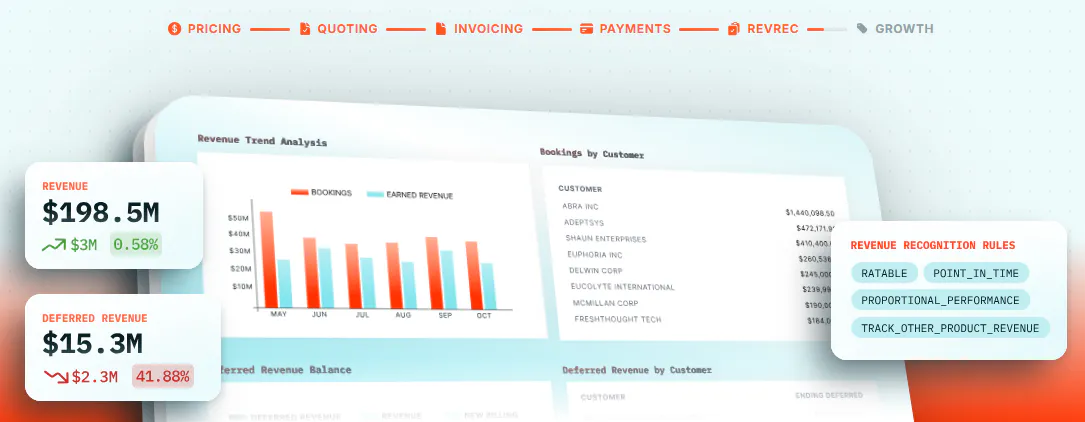
Chargebee is a subscription management and billing platform that automates billing, subscription management, and revenue recognition.
It can handle SaaS pricing plans and invoicing to tax compliance and financial reporting in one system. Its core value lies in simplifying complex recurring revenue models so companies can scale without relying on manual processes or engineering-heavy billing setups.
One of Chargebee’s strongest features is its flexible billing and monetization engine. With this tools you experiment with different pricing models, such as per-user, tiered, usage-based, or hybrid, before launching.
It also allows your teams to manage plans, features, and access dynamically. Combined with automated invoicing, global tax handling (like EU VAT and US sales tax), and support for multiple currencies and payment gateways, Chargebee makes it easier to operate internationally and adapt pricing strategies quickly.
Chargebee stands out for its financial operations and revenue intelligence capabilities. It offers built-in revenue recognition compliant with standards like ASC 606 and IFRS 15, along with real-time analytics, reporting dashboards, and seamless accounting integrations.
Features like dunning management (failed payment recovery), churn reduction tools, and automated collections help protect revenue, while its API-first approach gives developers flexibility to integrate deeply into existing systems. Overall, Chargebee acts as a central hub for managing the full lifecycle of subscription revenue—from acquisition to retention and reporting.
Best suited for:
Mid-sized to enterprise SaaS companies with complex pricing structures.
2. Stripe Billing
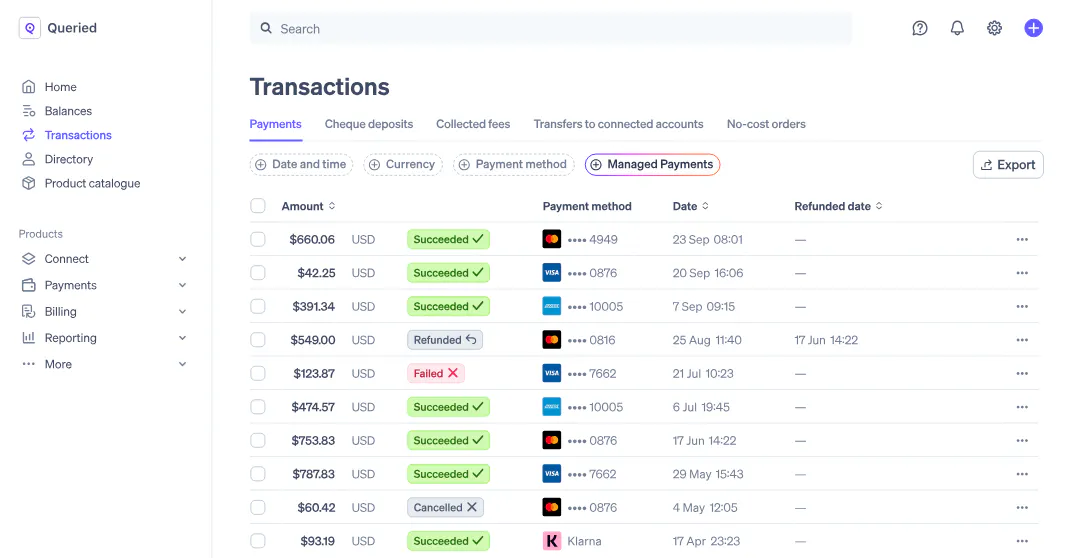
Stripe Billing is a developer-first subscription management solution that offers unmatched flexibility.
Because it is built on top of Stripe’s payment infrastructure, it allows you to fully customize billing logic through APIs. This makes it ideal for startups and scaling SaaS businesses.
Stripe Billing is built to support both simple subscription models and highly complex billing structures.
With Stripe Billing your company can create and manage subscription plans with dynamic pricing models, including flat-rate, tiered, per-seat, and metered usage-based billing. The platform also supports automated invoicing for both recurring and one-time payments, reducing manual billing overhead and improving revenue accuracy.
To ensure compliance and financial consistency, Stripe Billing integrates deeply with tax automation tools, handling global sales tax, VAT, and region-specific tax rules automatically.
Stripe provides revenue recognition capabilities, helping you align your financial reporting with accounting standards by automatically recognising revenue over time based on subscription terms and usage patterns.
Stripe Billing acts as a unified infrastructure layer for subscription and recurring revenue management, combining flexible pricing models, automated compliance, and financial reporting into a single system designed to scale with growing digital businesses.
Best suited for:
Startups and fast-growing SaaS companies with strong technical teams.
3. Recurly
Recurly is a subscription management and recurring billing platform designed to help your business launch, manage, and scale subscription-based revenue models.
It provides an infrastructure to handle the full subscription lifecycle, including plan creation, pricing configuration, billing, invoicing, and subscriber management, with a focus on supporting both simple and complex recurring revenue models.
With Recurly you can build flexible subscription offerings with support for multiple pricing structures such as flat-rate, tiered, and usage-based models. It handles upgrades, downgrades, pauses, renewals, and cancellations.
The platform offers an automated billing engine, which handles recurring payments, invoicing, proration, and payment retries. Recurly also includes revenue recovery tools designed to reduce involuntary churn by improving failed payment handling through retry logic and subscriber retention workflows.
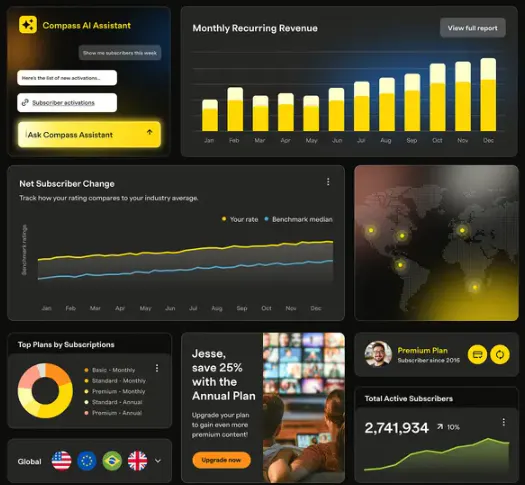
Recurly provides capabilities for subscription analytics and reporting, giving businesses visibility into metrics such as subscriber growth, churn, retention, and recurring revenue performance.
Best suited for:
Companies that need to improve retention and reduce involuntary churn.
4. Maxio
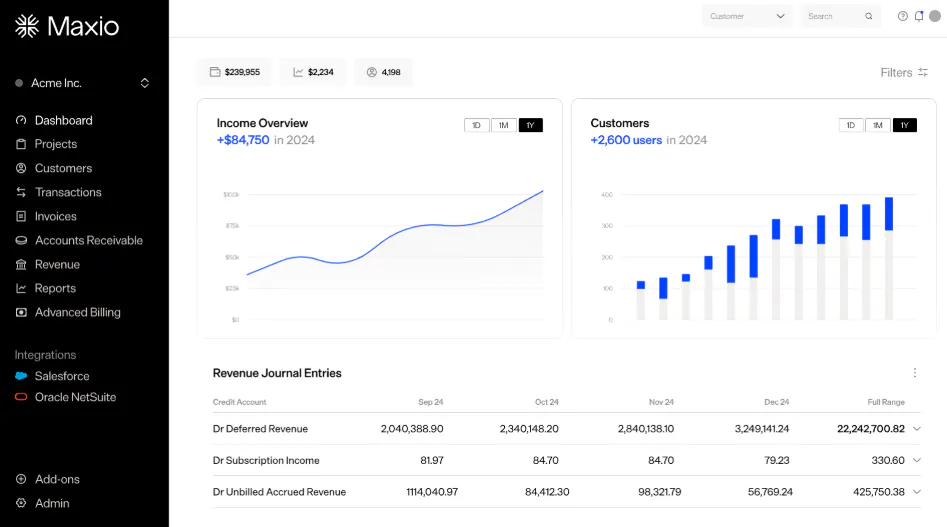
Maxio is specifically built for B2B SaaS companies. It unifies subscription management, billing, revenue recognition, SaaS metrics, and reporting into a single system.
It focuses on helping finance and operations teams automate the order-to-cash process and provides visibility and control over complex recurring revenue models.
Maxio provides a flexible subscription and billing engine that supports a wide range of monetization models, including subscription-based, usage-based, and hybrid pricing structures.
It allows your business to define product catalogs, manage contracts, automate invoicing, and set up renewal workflows.
The platform also supports advanced invoicing capabilities, enabling companies to generate and consolidate invoices at scale, apply discounts, manage multiple pricing components, and handle complex billing scenarios without overcomplicating the product catalog.
Maxio’s revenue operations layer includes revenue recognition functionality designed to align with accounting standards such as ASC 606.
Customer-facing tools include billing portals, that allows subscribers to manage payment methods, subscriptions, upgrades, and cancellations through self-service workflows. This reduces operational overhead while improving customer experience and transparency.
Best suited for:
B2B SaaS companies that need both billing and financial visibility.
5. Zuora
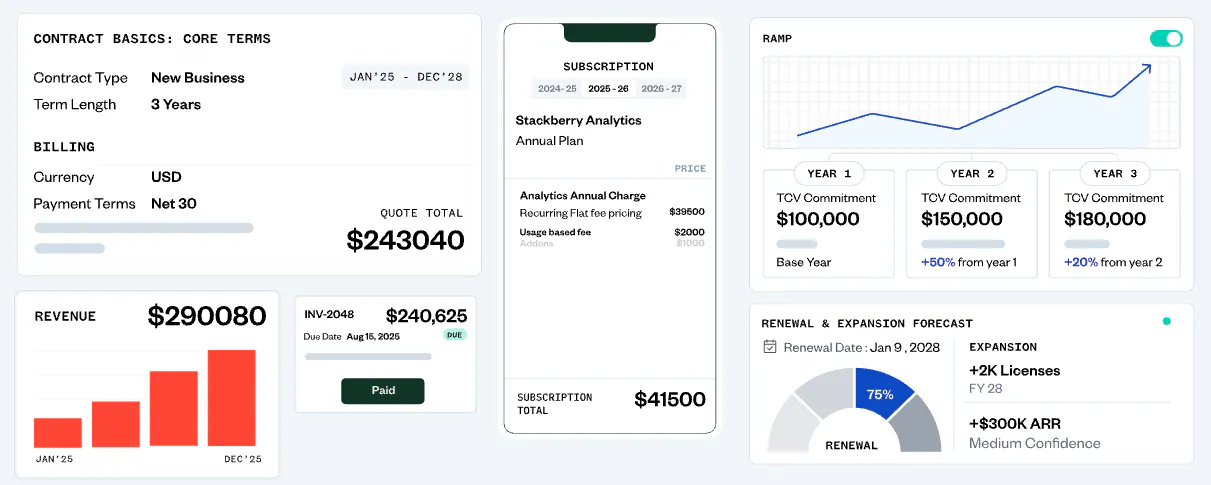
Zuora is an enterprise-grade subscription management platform built for large organizations with complex monetization strategies.
It brings together pricing, quoting, billing, payments, collections, and revenue recognition into a single system, allowing you to launch and scale recurring revenue models. Zuora positions itself as a full “subscription economy” platform that connects front-end monetization (offers, pricing, acquisition) with back-end finance (invoicing, compliance, reporting).
Zuora offers a modular suite that covers each stage of the revenue lifecycle.
Zuora Billing handles complex subscription and usage-based billing, Zuora Revenue automates revenue recognition and ensures compliance with standards like ASC 606 and IFRS 15.
Zuora CPQ (Configure, Price, Quote) supports sales teams in creating accurate quotes and managing pricing structures, and Zuora Payments orchestrates global payments and improves transaction success rates.
On the finance side, Zuora Collections automates accounts receivable workflows and recovery, finally, Zephr Paywall focuses on customer acquisition and monetization by enabling AI-driven paywalls and personalized subscription experiences, particularly for media and digital businesses.
Zuora also supports advanced capabilities like AR automation, AI-driven finance insights, and paywall-based acquisition.
Best suited for:
Large SaaS companies and enterprises with complex billing needs.
Subscription Management vs SaaS Spend Management
As we mentioned earlier, subscription management and spend management are completely different tools.
Subscription management manages subscribers to your business, spend management takes care of your subscriptions to other SaaS platforms.
SaaS Spend and Procurement Platforms
SaaS spend and procurement platforms focus on internal operations, helping IT and finance teams manage the software used within your organisation.
They provide:
- Visibility into all SaaS tools being used
- Cost tracking and spend optimisation
- Vendor and contract management
- Approval workflows for new purchases
The goal is to reduce overspending, improve governance, and eliminate inefficiencies.
Example of a SaaS spend management platform
Najar is a good example of a SaaS spend management platform, as it directly addresses a different but equally important challenge: managing internal SaaS spend and contracts.
Najar is not a traditional subscription management tool. It focuses on giving companies full visibility and control over the software they use internally.
It offers:
- Contract management: Track renewal dates and avoid unwanted auto-renewals
- Cost optimisation: Identify duplicate tools and reduce unnecessary spend
- Procurement workflows: Centralise requests, approvals, and vendor communication
- Negotiation support: Renegotiate pricing before contracts renew
This makes it particularly useful for companies dealing with shadow IT and fragmented SaaS usage.
When do you need SaaS subscription management software?
SaaS subscription management software is essential for any company that relies on recurring revenue. It guarantees that billing is accurate, subscriptions are managed efficiently, and revenue is predictable.
At the same time, managing internal SaaS spend is just as important. Tools like Najar provide visibility into contracts, renewals, and usage, helping companies control costs and eliminate inefficiencies.
The most effective approach is not choosing one over the other, but combining both:
- Subscription management software for revenue optimisation
- Spend management platforms for cost control and visibility