
Most companies focus on their biggest contracts, but they often miss the smaller purchases.
Office supplies, one-time software buys, unused licenses, and auto-renewing SaaS subscriptions might not seem important on their own, but together they can add up to a lot of waste.
It gets even harder to manage these costs without good SaaS portfolio management and license management processes.
These overlooked purchases are called tail spend, and they usually get little attention even though they can have a big impact over time.
What Is Tail Spend?
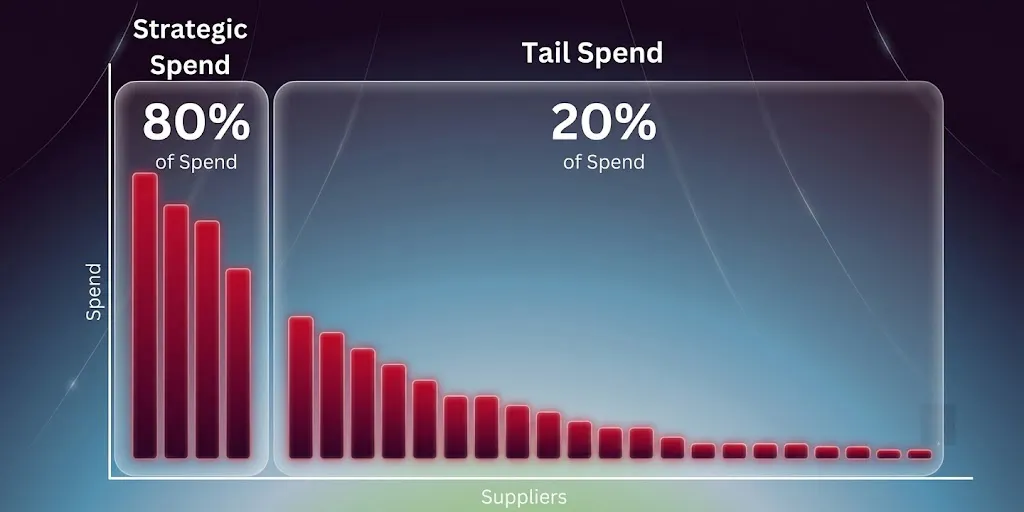
Tail spend is the large volume of small, low-value purchases that are not part of your main managed categories. These usually do not go through formal sourcing or proper negotiation.
Most organizations find that about 80% of their transactions account for only 20% of their total spend. That 20% is what we call the tail.
The exact numbers can change from business to business; some see a 70/30 or 90/10 split, but the pattern is the same: lots of suppliers, lots of invoices, and not much control.
Difference Between Tail Spend And SaaS Spend
Tail spend is based on the size and how purchases are managed, not what you buy. It includes all the small, scattered, low-value purchases outside your main managed spend, like office supplies, travel, freelancers, or software.
SaaS spend is defined by what you buy. It includes all your software subscriptions, from a single-user app to a company-wide platform, regardless of contract size.
There is some overlap between the two. Many SaaS purchases end up as tail spend, like one-off app subscriptions, single-user licenses, and free trials that become paid plans in different teams.
These small, unmanaged software purchases are a type of shadow IT that increases tail spend. However, they are not the same:
- Not all SaaS spend counts as tail spend. Major platforms are high-value, strategic, and usually well managed.
- Not all tail spend is related to SaaS. Much of it has nothing to do with software.
→ 💻 Learn how to reduce software costs with our guide to SaaS spend optimization.
In summary, managing tail spend means keeping track of all small purchases, while managing SaaS spend focuses on your software subscriptions. If software is a big part of your tail spend, the two are closely connected.
→💡 For more, read our guide on SaaS Spend Optimization: Risks, Benefits (+7 Step Winning Strategy)
How to Define the “Tail” in Your Organization
There is no single rule for what counts as tail spend. What is tail spend for one company might be a strategic purchase for another.
Most teams draw the line in one of three ways:
- Spend threshold: any vendor below a set annual amount, often somewhere from 100K to 1M.
- The Pareto split: the 80% of transactions that drive only 20% of spend.
- Management status: any vendor that procurement is not actively handling.
No matter which method you use, make sure all teams agree on the definition. Getting everyone on the same page is more important than the exact number.
What Tail Spend Actually Looks Like
Tail spend is much easier to picture with concrete examples. These are the kinds of small, scattered purchases that pile up across teams and quietly grow your bill:
Category | What teams actually buy |
Software | One-off app subscriptions, single-user licenses, free trials that turn into paid plans |
Office supplies | Paper, ink, stationery, kitchen and cleaning products |
Travel and events | Flights, hotels, taxis, team lunches, conference tickets |
Maintenance and repairs | Emergency fixes, spare parts, small equipment replacements |
Professional services | Freelancers, one-time consultants, translation or design gigs |
Marketing | Stock photos, small ad campaigns, design tools, sample orders |
IT hardware | Cables, adapters, keyboards, headsets, phone accessories |
On their own, each of these purchases is cheap and easy to approve. Together, they account for a large share of your transactions and a budget that no one is really watching.
8 Tips to Reduce and Control Tail Spend
You may not be able to eliminate tail spend completely, but with the right steps, you can reduce it and keep the rest in check.
1. Centralize and standardize buying
Make sure all low-value purchases go through the same channels, use the same forms, and follow the same approval rules. This prevents teams from making purchases on their own without any oversight. This creates a consistent process that finance and procurement teams can easily track.
→ 💻 For more, read Intake-to-Procure And How to Improve Procurement
2. Automate approvals
Don’t waste time manually reviewing every small purchase. Set up automated approval workflows based on simple rules such as:
- amount thresholds
- categories
- departments
- vendors
This speeds up decision-making, reduces back-and-forth, and frees procurement and finance teams to focus on higher-value sourcing and negotiation.
3. Consolidate suppliers
Tail spend often means dealing with dozens or even hundreds of vendors across different teams, each with their own pricing, invoicing terms, and points of contact.
By consolidating suppliers, you can reduce admin work, cut down on duplicate tools and overlapping services, and concentrate volume with fewer partners.
This usually leads to better negotiated rates, clearer SLAs, simpler approvals, and stronger leverage when contracts come up for renewal.
4. Enforce clear spending policies
Set simple rules around what can be purchased, from whom, and within which budget limits. Clear policies reduce unauthorized spending and improve compliance.
A simple tail spend policy should spell out:
- What people can buy: the categories and types of purchases that are allowed, so "business-related" is not left open to each person's interpretation.
- Who they can buy from: the preferred or pre-approved vendors to check first before anyone goes looking elsewhere.
- Spending limits: clear thresholds for what someone can buy on their own, and the amount above which a purchase needs sign-off.
- Who approves what: the person responsible for approving each request, usually a manager or department head, along with the receipts or notes they need to see.
- How it gets reviewed: a regular check of spending against the policy to catch duplicates, off-policy buys, and savings opportunities.
Keep it short and written in plain language, since people will skim a policy rather than read it line by line. A document buried in detail is one that gets ignored.
5. Use approved catalogs
Give employees easy access to pre-approved products, services, and vendors through a simple catalog or buying portal.
It’s important to make clear what is allowed, what is not, and how to request an exception when needed. When the approved option is faster than buying off-process, most people will follow it, and maverick spending drops naturally.
6. Increase spend visibility
Because these purchases are small and spread across many teams, vendors, and payment methods, the data behind them ends up scattered and inconsistent.
The fix is to bring every purchase into one clean, normalized view, so once the data is consolidated and categorized, patterns surface that no single team could spot on its own:
- Duplicate tools: several departments paying for the same software without realizing it.
- Hidden vendors: one supplier showing up under four slightly different names.
- Creeping costs: small subscriptions and renewals that quietly grow quarter after quarter.
- Off-policy buys: purchases that skipped the approved process entirely.
That visibility turns vague suspicions into concrete numbers you can act on, and it is the foundation on which every other strategy here depends.
Without it, you are guessing; with it, you know exactly where the waste sits and what it is worth.
7. Track contracts and renewals
Small contracts rarely get the same attention as big ones, which is exactly why they quietly drain budgets over time.
Many of them renew on their own at rates no one ever reviewed, so the first step is simply knowing what you have and when it comes up. Keep a single, shared record of every contract and stay on top of:
- Renewal dates: so a contract never rolls over before you have had a chance to look at it.
- Notice periods: the deadline to cancel or renegotiate, which is often buried in the fine print.
- Pricing and terms: what you agreed to last time, so you can spot increases and benchmark against the market.
- Actual usage: whether you still need the tool, and at the current seat count, before you commit again.
A little preparation ahead of each renewal is what shifts the leverage back to you. Instead of reacting days before a deadline, you have the time to renegotiate, downgrade, or walk away.
8. Use the “Crawl, walk, run” approach
Trying to fix all of your tail spend at once is overwhelming, and it is usually why these efforts stall before they show any results.
A better approach is to start with a single, manageable slice and build from there:
- Crawl: Start with one business unit or spend category. Get stakeholder buy-in and connect the right tools to your P2P or ERP system.
- Walk: Expand the program gradually and introduce more automation. Better data and processes will help build momentum and demonstrate value.
- Run: Once you've proven results, roll out the program across the organization and automate as much as possible. This frees procurement teams to focus on higher-value strategic work instead of managing small purchases.
Each early win builds momentum and makes the next stage far easier to sell internally. Over time, these small rollouts add up to a process that covers the whole organization, without ever feeling like a massive project.
Tail Spend Outsourcing vs. In-House Management
Deciding whether to manage tail spend in-house or outsource it comes down to your organization’s strengths and how your spending is structured.
If your company has solid procurement systems, accurate spend data, and automated purchasing, you can usually handle tail spend internally and stay in control of policies.
Outsourcing works better when tail spend is spread across many suppliers and departments, which can make in-house management expensive and slow.
Specialized providers bring analytics, supplier consolidation, and procurement know-how to help you save money and work more efficiently.
The right approach depends on your resources, procurement maturity, and ability to manage complexity at scale.
Whichever route you take, the aim is to reduce complexity for good rather than simply move it somewhere else.
Benefits of Managing Tail Spend
When you manage tail spend, you often see results fast. Studies show that using digital tools for tail spend can lower annual costs by 5% to 10% and save up to 20% of your total spend in this area.
Here’s what you can expect in practice:
- Direct cost savings: By consolidating vendors and negotiating better rates, you pay less for purchases that previously went through at full price.
- Faster cycle times: Automated approvals and catalogs cut out manual steps, so requests move from start to finish much faster.
- More spend under management: When small purchases follow a set process, much less of your budget is lost to off-contract spending.
- Cleaner data: Keeping all purchases in one consistent record makes reporting and forecasting more accurate and reliable.
- Lower risk: Using approved suppliers helps close security and compliance gaps that can happen with scattered vendors.
- More time: with the busywork automated, your team can focus on strategic sourcing and higher-value projects.
Handled well, these small purchases end up delivering returns far larger than their size would suggest.
How to Choose Tail Spend Management Software
Choosing the right platform helps you put your strategy into action. Here are some practical criteria to consider when comparing your options:
- Full spend coverage: The tool should show direct and indirect spend, products, and services all in one place. This way, nothing in your tail spend is overlooked.
- Process efficiency: Choose a tool with automated purchase orders, invoice matching, and approvals to reduce manual work for your team.
- Ease of use: A simple, catalog-based tool is important. If people find the tool hard to use, they will likely avoid it.
- Supplier management: Managing all your vendors in one place helps you keep your supplier base organized and under control.
- Integration: Your ERP or P2P system connects directly, so data moves automatically, and you no longer have to enter it by hand.
It’s better to have a tool your team actually uses than one with lots of features that go unused. If no one uses it, it won’t save you anything.
→💡 For a side-by-side breakdown, see our guide to the best SaaS management platforms
Case Study: How Back Market Gained Control Over Scattered Spending
Back Market leads the refurbished-device market and has about 700 employees across 16 countries. As they worked toward profitability, their purchasing became reactive and difficult to track, a common issue with tail spend.
Types of tools they used:
CMS, Search & Discovery, Productivity & Collaboration Suite, Data Integration, Customer Engagement
Before Najar
Last-minute negotiations, with limited time to challenge scope, benchmark pricing, or drive savings
Contracts tracked manually across three tools
No external reference point to benchmark SaaS pricing
Overlapping tools sometimes went unnoticed across teams, creating avoidable costs
One person managed procurement part-time with limited capacity for RFPs or complex evaluations
After Najar
Renewals are anticipated months ahead and negotiations start from a position of preparation
Contract information consistent, accessible, and no longer dependent on individual tool owners
Every negotiation is informed by market expertise and competitor alternatives
Scope challenged and license needs questioned on every purchase
Najar's IT buyers cover everything from day-to-day negotiations to full end-to-end Procurement
Najar lets you plan renewals months in advance and keeps all your contract details in one easy-to-access place.
Najar’s IT buyers reviewed every purchase, checked whether licenses are required, and compared prices with market rates.
In 1 year, Back Market saved an average of 16% per negotiation and recovered about 300 hours of procurement time.
““The number one asset of Najar is having somebody consistently available with great expertise””
How Najar Keeps Your Tail Spend Under Control
Najar is Europe’s fastest-growing spend management platform, designed for scaleups and enterprises facing software sprawl and numerous small, scattered purchases.
You get the control of a full management platform and the benefits of an in-house procurement team, without having to hire extra staff.
On average, our clients save up to 36% on software costs through expert negotiation and better contract terms. Some have even saved over 45%.
Our platform handles the entire procurement cycle in one place, from purchase requests to contract management and renewal tracking, so the small buys that usually slip through the cracks finally have a process.
On average, customers see a 7x return on investment and save over 300 hours each year.
Collaborative approval rooms keep finance, IT, and legal teams aligned on every decision, even the low-value ones that normally go unchecked.
Our procurement team handles vendor sourcing for you, negotiating pricing, terms, usage rights, and support clauses.
Najar focuses on Europe, providing detailed regional vendor data and a strong local presence for customers in the area.
Unmanaged tail spend grows each quarter, leading to more tools, renewals, and blind spots. Najar gives you full visibility, helps reduce wasted spending, and controls shadow buying before it becomes a problem.
To see how Najar can work with your current workflows.
FAQs
What is tail spend?
Tail spend refers to the many small, low-value purchases that are not part of your managed categories. These usually make up about 20% of your total spend but account for most transactions.
What is tail spend analysis?
This means bringing all your spend data together in one place to spot the long tail of low-value, frequent purchases. This way, you can see where to consolidate, automate, or renegotiate.
What are common tail spend categories?
Common examples are office supplies, basic maintenance, MRO parts, one-time software purchases, freelancers, and occasional professional services.
Should you outsource tail spend management?
Outsourcing is a good option if your spending is spread out or your team is short on time. Managing it in-house works best if you have strong data and centralized buying.
How do you reduce tail spend?
Centralize your buying, reduce the number of suppliers, automate approvals, and set clear policies. Track your results and repeat these steps with each team.
What software helps manage tail spend?
Choose spend management or procurement platforms that offer automation, pre-approved catalogs, supplier management, and easy ERP integration.