
Global SaaS spending hit $300 billion in 2025, growing at nearly 20% year-over-year, yet most organizations are still negotiating these contracts the same way they did a decade ago.
Because many Procurement teams have limited resources and handle many topics, they often end up reacting to issues instead of planning ahead.
They accept the first quote, miss renewal windows, and often end up paying more than necessary for software they may not be fully using.
Understanding how to negotiate SaaS pricing effectively is a strategic advantage that impacts budget control, vendor flexibility, and long-term software ROI.
This guide lays out a proven 6-step framework that procurement professionals use to win on pricing, terms, and flexibility, whether they are signing a new contract or heading into a renewal.
Why You Should Never Skip a SaaS Pricing Negotiation
Boston Consulting Group reports that SaaS spending rose from 13% to 21% of total IT budgets over the past 5 years. As growth slows, vendors are raising prices, adding AI features, and experimenting with new pricing models to maintain profits.
This means the contracts you renewed last year are steadily becoming your biggest software expense.
Beyond direct cost savings, structured negotiation delivers:
- Better contractual flexibility, including pause clauses, downsizing rights, and exit provisions
- Stronger SLAs (Service Level Agreements) and support commitments that protect operations
- Price cap agreements that prevent surprise hikes mid-contract
- Data portability and GDPR-aligned processing terms
- Free access to premium features or integrations as non-cash value
Choosing not to negotiate means you are leaving money on the table and fully accepting the vendor’s terms.
What Are The Most Common SaaS Pricing Models
Before you start negotiating, make sure you understand what is actually on the table.
SaaS vendors use different pricing models, and each comes with its own negotiation challenges, risks, and potential hidden costs.
Understanding your contract’s pricing model helps you know where to focus and what to request during negotiations.
1. Subscription-based pricing (flat-rate)
One fixed price for the full product, regardless of users or usage. Simple to budget, but often overpriced for smaller teams that do not use the full feature set.
2. Tiered pricing
Features become available at higher price levels. Vendors will often encourage you to move to a more expensive tier. Be clear about which tier you need and stick to it.
3. Per-user pricing (seat-based)
Costs increase as you add more licences. This is the most common pricing model and often leads to wasted licences when your team size changes or onboarding takes time.
4. Usage-based pricing (pay-as-you-go)
You are charged based on how much you use, like API calls, records processed, or storage. While this model is flexible, it can be unpredictable if you do not closely track your usage.
5. Freemium model
There is a free tier to start, but you pay for advanced features. Be aware of tactics that limit features to encourage you to upgrade when you may not need to.
6. Feature-based pricing
Each feature is priced on its own. This lets you buy only what you need, but if you do not review your choices, the total cost can end up higher than a bundled plan.
7. Custom/enterprise pricing
This pricing is worked out directly with the vendor. It is the most important negotiation, so preparation, knowing benchmarks, and having leverage are key.
Develop your SaaS Pricing negotiation strategy
There is no one-size-fits-all strategy. The best approach depends on your relationship with the vendor and how much leverage you really have.
Collaborative approach: Position the negotiation as a partnership where both parties find mutual value. Emphasise long-term relationship building and shared success metrics. This works well when you genuinely value the vendor relationship and expect a multi-year partnership.
Competitive approach: Leverage alternative vendors to drive concessions through competitive pressure. Use specific competitor pricing and features to demonstrate market rates. This approach works when you have strong alternatives, and the vendor knows it.
Value-based approach: Justify pricing through ROI and measurable business outcomes. Focus the conversation on value delivery rather than cost. This works when you can demonstrate a concrete financial impact from the software.
Next, set clear and measurable goals for what you want to achieve:
- Price reduction targets
- Payment terms (annual, quarterly, or monthly billing)
- Contract length (1-year, 2-year, or 3-year commitment)
- Renewal caps to limit future price increases
- Service level commitments and support tiers
- Termination flexibility and exit clauses
How to Negotiate SaaS Pricing in a 6-Step Framework
A successful negotiation starts before you even contact the vendor.
Preparation is what sets top procurement teams and organizations with the right SaaS management tools apart from those who simply accept vendor terms.
Step 1: Audit your current SaaS usage
On average, 75% of IT teams have no clear view of what SaaS apps are being used or when subscriptions renew. You need to know exactly what you have and what you use to negotiate from a strong position.
Start by identifying unused or underused licences; these are your primary targets. Then, analyze feature adoption rates and map out which tools overlap in functionality.
Step 2: Research the vendor
Vendors have their own pressures, sales targets, and areas where they may not be as strong as competitors. You can use this information to your advantage.
- Check G2, Gartner Peer Insights, and TrustRadius for contract satisfaction signals
- Research competitor pricing and freely available benchmarks for that software category
- Assess the vendor’s financial health; early-stage vendors are often more flexible on price, later-stage ones on terms
- Identify typical discount ranges using platforms like Najar’s pricing intelligence database.
Step 3: Define your needs
Before you start negotiating, decide what success looks like for you:
- Set a clear cost reduction target as a percentage or absolute figure
- Separate must-have features from nice-to-have features
- Establish your BATNA before the first conversation
Also, think about how flexible you can be with the contract. For example, can you agree to a longer term for a better price, or do you need exit clauses to keep your options open?
Step 4: Identify your leverage points
You have to create leverage; it does not just appear.
- Volume: committing to more seats in exchange for a lower unit price
- Multi-year commitment: vendors value ARR predictability and will price for it
- Competitive alternatives: A credible competing offer changes the dynamic immediately
- Usage data showing underutilization: the case for downgrading or renegotiating the tier
- Termination rights: if your contract allows an exit, remind the vendor of it
Step 5: Review contract terms carefully
If you overlook things like auto-renewal clauses, notice periods, or limits on price increases, your costs can rise quickly later on.
It's also worth calculating the total cost of ownership (TCO) before signing because the license fee usually does not show the whole cost.
On top of subscription fees, you need to factor in:
- Implementation and setup costs
- Team training
- Integration work
- Ongoing support
- Any customization required to make the tool actually fit your workflows.
Knowing your TCO also gives your team a strong advantage in negotiations. If you can show a vendor the full cost, not just the license fee, you have a better chance to challenge prices or ask for free setup help as part of the deal.
It's also important to check service agreements, support choices, and any hidden fees so you are not caught off guard by extra costs later.
→ Read also: Understanding the total cost of ownership of SaaS
Step 6: Time your negotiation strategically
Vendor sales teams operate on quarterly and annual quotas.
- Sales reps have the most flexibility to offer discounts in the last two weeks of March, June, September, and December.
- Negotiating at the end of the year, especially in November and December, often leads to the biggest discounts.
- Avoid negotiating right after a vendor launches a major product. They are less likely to offer discounts at that time.
8 Strategic Levers to Use When Negotiating SaaS Contracts
The best negotiators use several strategies at once, like adjusting contract terms, pricing, and the vendor relationship to lower costs and get more value over time.
1. Loyalty leverage
If you’re already a customer, your renewal deserves different treatment from a new purchase. Vendors spend a lot to win new customers, so keeping existing ones is valuable to them.
You can leverage your long-term relationship and renewal track record to request loyalty discounts or better pricing.
2. Portfolio and bundling leverage
If your company uses several products or services from one vendor, bring all that spending into one negotiation. Bundling contracts across different products can help you get discounts, better terms, or more features for less money.
3. Contract length leverage
Making a longer commitment can give you more leverage in negotiations. Signing a multi-year deal can lower your per-user or per-unit costs, since vendors value steady, predictable revenue.
Even if you’re not sure about a long-term deal, asking for 2- or 3-year pricing gives you helpful benchmarks for comparison.
4. Payment structure leverage
The way you pay is often as negotiable as the price itself. Paying for a year upfront often gets you bigger discounts, while paying quarterly can help balance savings and cash flow.
By negotiating payment terms, you can save money without changing what you get from the product.
5. Licence right-sizing leverage
Renewal time is the perfect time to cut out anything you don’t need. Before you negotiate, check how many users are active, which features you use, how much storage you need, and any add-ons you don’t use.
Reducing unnecessary licences or downgrading underused tiers ensures you negotiate based on actual business needs rather than inflated historical spend.
6. Growth commitment leverage
You can often trade future growth for savings today. If your organization expects to expand usage, add seats, or scale departments, use that projected growth as a bargaining chip.
Agreeing to grow in phases can help you get lower prices now in return for steady growth later.
7. Brand and reference leverage
Your company’s reputation can be valuable in negotiations. If your company is well-known or respected, you might get discounts by offering testimonials or case studies, or by acting as a reference.
For vendors, your logo can be a marketing asset that translates into pricing power.
8. Strategic customer value leverage
Some customers are more valuable to vendors than others. Your company’s size, influence, growth potential, or reputation might make you more important to the vendor than a typical customer.
Be sure vendors see your full business value, so your contract includes better pricing, service, or flexibility.
How to Handle Common Vendor Objections
Vendors use the same objections in almost every negotiation. Knowing them in advance means you never get caught off guard or pressured into accepting terms you did not plan to accept.
- "Our pricing is based on the value we deliver, not what competitors charge."
Reply with: "We agree value matters, but based on our usage data, we are not using the full scope of what we are paying for. Can we find a structure that better matches what we need?"
Why it works: Value-based pricing arguments cut both ways. If they are invoking value, so can you, and your usage data is the proof.
- “We cannot go below list price.”
Reply with: “If price is fixed, what flexibility do you have on contract length, support tiers, or additional seats?”
Why it works: Shifting to non-price value often unlocks concessions the rep has more authority to offer.
- “This offer expires today.”
Reply with: “We do not sign without internal sign-off from finance and legal. If the offer is genuine, it will still be available next week.”
Why it works: A vendor who pulls a real offer over a 48-hour review period is one you should walk away from anyway.
- “Our competitors are more expensive.”
Reply with: “Can you provide a feature-by-feature comparison? We want to make sure we are paying for what we actually use, not capabilities we will not need.”
Why it works: This puts the burden of proof back on the vendor.
- “The price increase is standard across all our customers.”
Reply with: “We would like to stay and grow with you, but we need the numbers to work. Does our usage history and contract size not give us grounds for a different conversation?”
Why it works: It is not a policy. It is a deflection. Treat it as one.
Negotiating With a New Vendor vs. Renewing With an Existing One
The main ideas behind SaaS negotiation stay the same, but your approach should change based on whether you are starting with a new vendor or working with one you already have.
Each situation offers its own leverage, risks, and chances to get a better deal.
Negotiating with a new vendor
If you are making your first purchase, you have time and options on your side. The vendor knows they have not secured your business yet.
Their sales team wants to close the deal, but you have no switching costs, migration risks, or sunk costs tying you down. This gives you real leverage, so make the most of it.
What to focus on:
- Bring competing quotes to the table. Even if you already have a favorite vendor, showing two or three alternatives proves you are a serious buyer who has done your homework and is ready to walk away if needed.
- Push for the best starting price you can get. The price you set now will be the baseline for future renewals. Even a 10% discount today can add up to big savings over several years.
- Ask for a shorter initial contract. A one-year agreement with a renewal option lets you test the software before making a long-term commitment.
- Ask to have implementation, onboarding, and training included. These cost little for the vendor but are valuable for you, and they are usually negotiable when starting a new deal.
- Secure a price cap for future renewals before you sign anything. Ask for a contract limit on yearly price increases. Vendors are much more likely to agree to this at the start than later on.
Renewing with an existing vendor
Renewals are a different experience, and vendors know it. The familiarity can actually work against you, since your team is already using the tool.
You have integrations, workflows, and habits built around the tool. Vendors know switching is tough, and their renewal strategy takes advantage of that.
But renewals are not a foregone conclusion; they are a negotiation, and you have more leverage than you think.
What to focus on:
- Gather your usage data before you start talking. If usage is low, use that to ask for a lower tier, fewer seats, or a price cut. If usage is high, use it to push for volume pricing or a loyalty discount.
- Begin the renewal process 90 days before your contract ends, not just 30. If you wait for the renewal notice, you are already short on time. Starting early lets you compare options and avoids the stress of an automatic renewal.
- Check what the market is offering. Vendors often think loyal customers will not look elsewhere. Show them you have done your research by bringing real competitor pricing as a benchmark, not just as a bluff.
- Negotiate the contract terms, not just the price. If the vendor will not lower the cost, ask for better service agreements, extra user seats for free, access to premium features, or a more flexible exit option. There are many ways to add value.
- Remind the vendor what it would cost them if you left. For SaaS companies, getting a new customer costs five to seven times more than keeping an existing one. You are not just another renewal, you represent a big marketing and sales expense they would rather avoid. Make sure they understand that during your talks.
💡The golden rule for both cases
Whichever side of the table you are on, never negotiate without data.
Whether it is usage metrics, competitor quotes, or contract benchmarks, the team with the better information almost always walks away with the better deal.
Clauses to Negotiate in SaaS Contracts
Experienced procurement teams understand that the contract itself, not just the price, shapes long-term value.
- Pricing and discount clauses: Ask for annual price increase caps tied to CPI or a fixed ceiling of 5%, multi-year discount lock-ins, and volume tier commitments that reduce the unit price as you scale.
- Flexibility clauses: Ask for the ability to reduce seat numbers during the contract, pause the agreement if business slows down, and end the contract early without heavy exit fees. These terms protect you if your needs change.
- Legal and compliance clauses: Make sure your contract includes GDPR-compliant data processing, clear information about sub-processors, the ability to take your data with you if you leave, and enforceable SLA credits. These are essential for firms handling client data.
For a deeper look at clause-level strategy, see our guide on SaaS contract management best practices.
⚠️ Common mistakes to avoid
- Waiting until the last minute: by the time the renewal notice arrives, your leverage is nearly gone
- Accepting the list price without question: vendors build in negotiation margin as standard practice
- Overcommitting to licences: buying 200 seats when 140 are active wastes budget and weakens future negotiations
- Ignoring contract fine print: auto-renewal clauses, price escalators, and limited exit rights are buried deliberately
- Failing to involve finance or procurement: departmental shadow purchasing bypasses institutional knowledge and leverage
Use Najar's Expertise to Negotiate Better SaaS Deals
What sets Najar apart is the combination of procurement intelligence and hands-on negotiation expertise, not just a dashboard, but a team that goes to the table with you.
Finance and procurement teams get full visibility over their entire SaaS portfolio: every subscription, every renewal date, every vendor commitment, in one place.
When it comes to negotiating, Najar stands out through its strategic expertise.
Najar's team of Procurement Partners are experienced IT buyers who manage every part of the deal, including price, contract terms, and how the product can be used.
They also help you create a comprehensive SaaS buying and negotiation plan tailored to your business needs.
Najar offers different negotiation options so you can choose how involved you wish to be in the process.
For example, you can negotiate with our coaching help, work together with Najar's expert IT Procurement Partners, or fully hand over the process so they manage to a third party everhandles for you.
You choose based on your priorities whether to hand over important projects or have Najar manage smaller, less frequent expenses.
Beyond negotiations, Najar also offers the following features:
1. Full SaaS discovery and inventory Get a complete picture of every tool, licence, and vendor relationship across your organization, so you walk into every negotiation knowing exactly what you have, what you are paying, and who owns it.
2. Usage and spend tracking Identify underused licences and inflated spend before your next renewal. Knowing your actual utilisation rate is one of the strongest cards you can play at the negotiating table.
3. Smart purchase requests Standardise how new software requests are submitted, routed, and approved, so no tool enters your stack without proper scrutiny and budget sign-off.
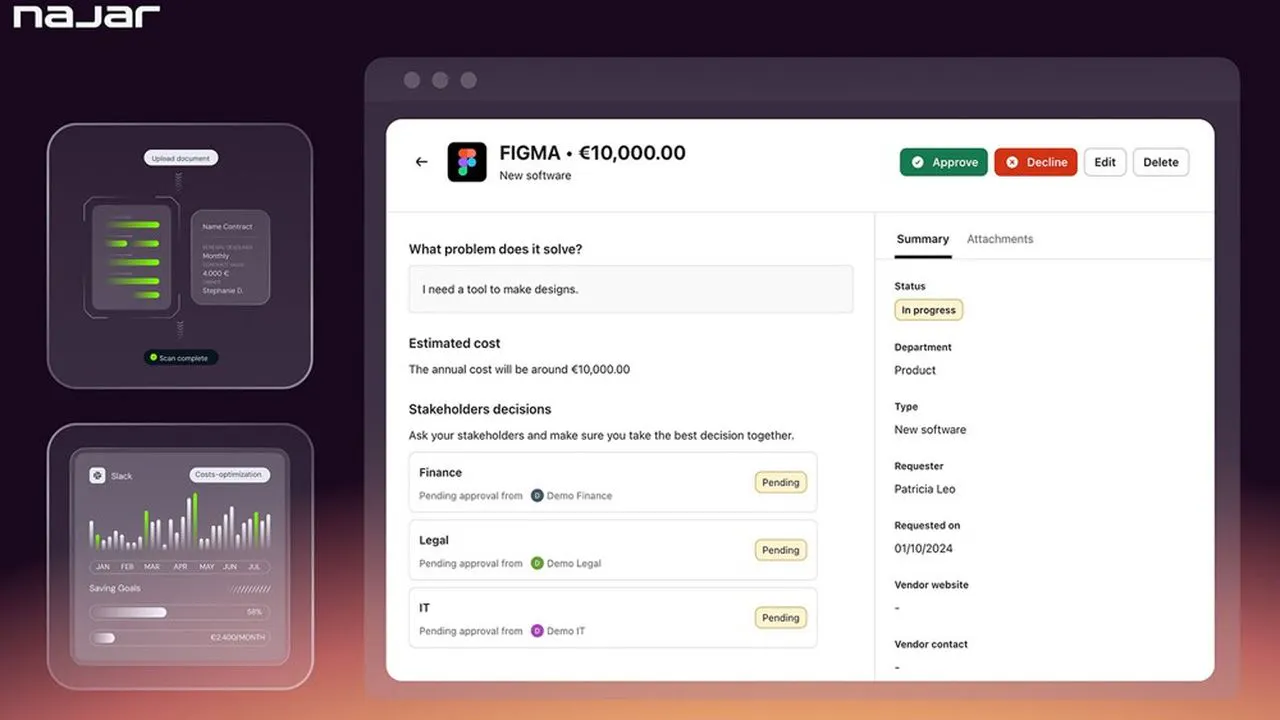
4. Collaborative approval and procurement hub Bring finance, IT, and legal into the same space to evaluate vendors and align on terms before committing, no more siloed decisions that weaken your negotiating position.
5. Vendor sourcing and negotiation support Najar's procurement specialists benchmark pricing, surface alternatives, and negotiate directly on your behalf, turning vendor conversations from reactive to fully prepared.
6. Contract and renewal management Never miss a renewal window again. Najar centralises all your contracts, flags upcoming deadlines, and prevents the auto-renewals that lock you into terms you never had the chance to challenge.
7. AI-powered insights and automation Forecasting, spend benchmarking, and actionable recommendations, delivered automatically, so your team can focus on the negotiations that matter rather than manual data gathering.
The results speak for themselves: clients save up to 36% with some unlocking savings above 45%.